
HASC News
In Conversation with Dr. Sharda

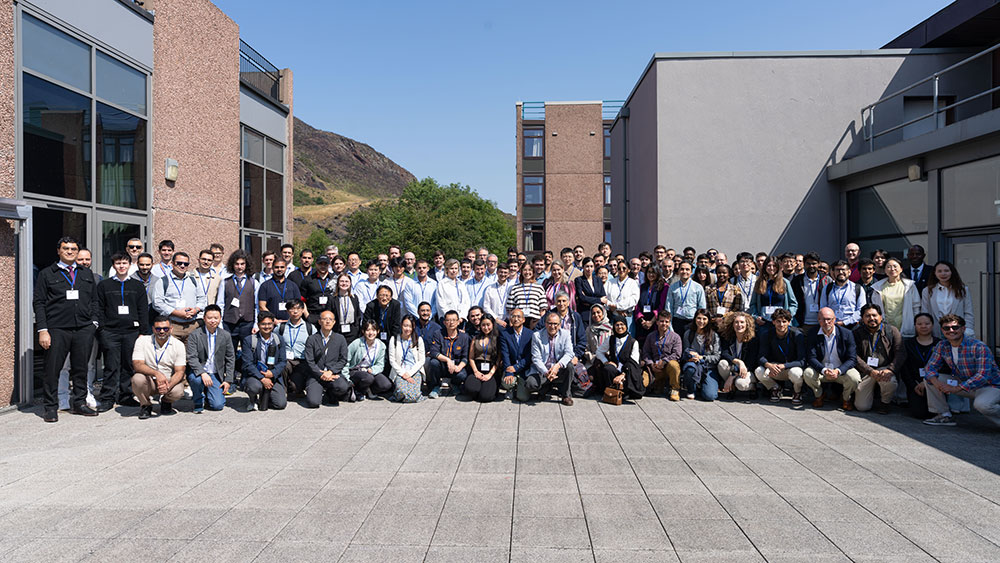
Team photo of the CSNDSP 2026 conference 15th-17th July 2026
From 15–17 July 2026, researchers from around the world gathered at the University of Edinburgh for the IEEE 15th International Symposium on Communication Systems, Networks and Digital Signal Processing (CSNDSP 2026). Since 1998, CSNDSP has become a leading forum for researchers and industry specialists to share ideas, present research and discuss future communications technologies.
The symposium comes at a time when communications technologies are evolving faster than ever. Exploring the future of global connectivity, this year’s agenda dived deep into innovations such as 6G networks, optical wireless and AI, cyber security and energy-efficient networking. Through keynote talks, technical sessions, specialist colloquiums and poster presentations, delegates had the opportunity to share new research, build international collaborations and discuss solutions to some of the sector’s most pressing technical challenges.
Representing HASC, Dr. Pranav Sharda presented his research on the topic “Indoor Visible Light Communications: Modelling and Channel Bandwidth Aspects of a Real Indoor Office Room”. Following the symposium, we caught up with him to discuss his research, the value of participating in international conferences such as CSNDSP, and the key insights he brought back from this year’s event.
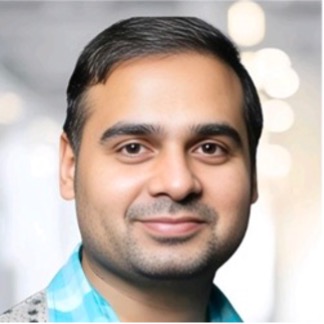
Dr. Pranav Sharda PhD, Postdoctoral Research Fellow, University of Oxford, HASC
Why Did You Attend IEEE CSNDSP 2026?
There were three things pulling me towards CSNDSP this year, summarised below:
The first was simply to put my work in front of the research community. I presented my research on optical wireless communications and desired honest feedback from researchers working in the same space – not just recognition, but genuine critique. That kind of scrutiny provides feedback on whether a contribution truly holds and directs to where the work needs to go next, so it is crucial.
The second was the people. A conference like this is as much about the conversations in the corridor as the talks on stage, and this year delivered a couple of exchanges I’ll definitely be following up on. I had a great discussion with Prof. Rafael Perez Jimenez, a co-author on a poster covering ontology-driven social digital twins with optical camera communications localisation for real-time customer-service operations – in plain terms, using light-based optical cameras to track people and objects in real time and feed that into a live digital model of a space, for things like smarter customer service. It’s a genuinely different angle on optical wireless that I hadn’t considered applying in that context. I also spent time with Hichem Zimi from the University of Strathclyde, whose poster covered 1.5 Gbps optical wireless communications using far-UV-C micro-LEDs – essentially, very fast wireless data sent over a part of the light spectrum invisible to the human eye. It was a great knowledge exchange, and high-speed UV-C links are a direction I’ll be keeping an eye on.
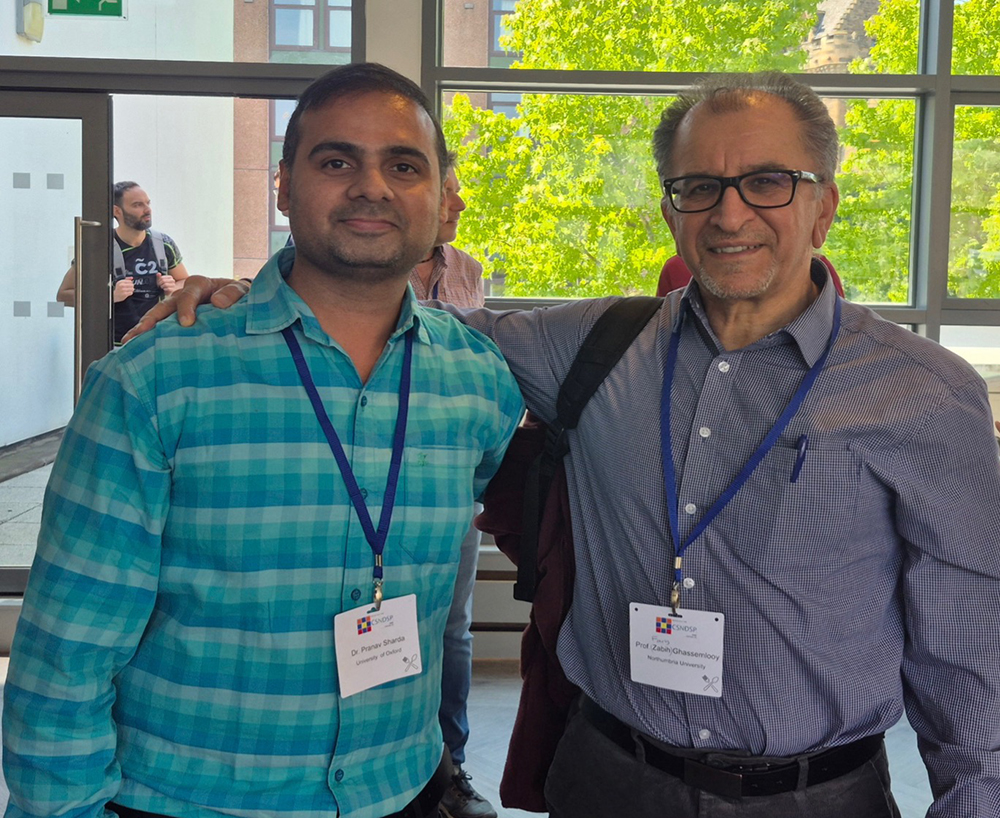
Left to right: Dr. Pranav Sharda PhD, Postdoctoral Research Fellow, University of Oxford, with Professor Fary at CSNDSP26
Conversations like these are exactly why in-person events still matter: they open research directions you wouldn’t stumble across from a literature search alone, and they’re often where future research collaborations start.
The third reason was simply to see what else is happening in the field. Communication systems and wireless research move quickly, and CSNDSP is a good snapshot of where the community’s attention is heading next.
Tell Us About Your Research
At CSNDSP 2026, I presented my research paper entitled “Indoor Visible Light Communications: Modelling and Channel Bandwidth Aspects of a Real Indoor Office Room”.
The research idea in brief: Indoor visible light communication (VLC) is emerging as a genuinely useful technique to deliver wireless connectivity inside buildings, using the same LEDs that light a room to also carry wireless data.

The research problem: Most VLC research relies on idealised, generic room models. That’s fine for early-stage theory, but it doesn’t tell you much about how the technology will actually perform once it meets a real space, including furniture, challenging layouts, reflective surfaces, etc. Therefore, I modelled a real indoor office room in Oxford to study how VLC-based optical wireless signals practically propagate through it.
Research finding: In plain terms, how fast and reliable your optical wireless connection is, depends strongly on exactly where you’re sitting in the office room. If we move our desk a metre, the usable data rate can shift noticeably. Technically, I measured this by tracking the 3 dB channel bandwidth. The standard metric for how much data a VLC-based indoor optical wireless link can carry as a function of receiver position, employing commercial LEDs mounted along the ceiling’s central axis. That gives a realistic, end-to-end picture of optical wireless performance, rather than the idealised best-case numbers most VLC studies report.
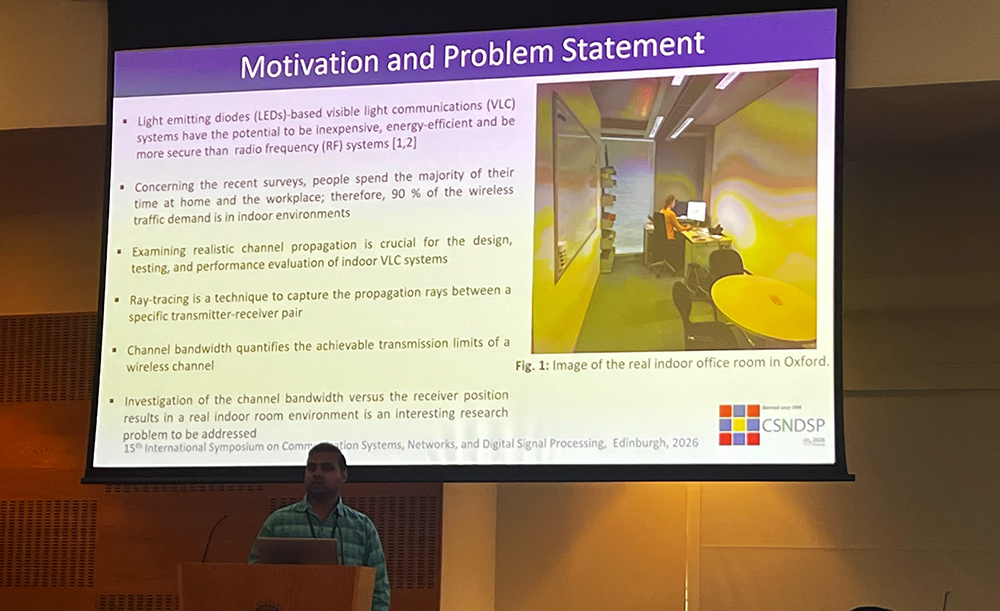
Dr. Pranav Sharda presents his research paper entitled “Indoor Visible Light Communications: Modelling and Channel Bandwidth Aspects of a Real Indoor Office Room”, at CSNDSP26
The research solution: I built a real office room in Oxford as a full model in Zemax OpticStudio, a commercial optical design tool, creating a foundational indoor VLC model that other researchers can extend for future studies. It also gives engineers a way to test and verify a proposed VLC system before committing to real-world deployment. This matters immensely, because physical testing is expensive and time-consuming.
Why it matters beyond the lab: It has attracted great interest from industry. I’ve had encouraging conversations with both Ericsson and Nokia Bell Labs. Particularly, Sebastien Nigo from Nokia Bell Labs attended CSNDSP 2026. In April 2026, I presented these results directly to the Ericsson team, and they found the work genuinely interesting. The model, and the concrete propagation data it produces, is exactly the kind of input that design engineers need when planning real, commercial indoor VLC deployments.
What Are Your Key Takeaways from the Event?
- Spectrum frugality will define 6G- from Prof. Muhammad Imran (University of Glasgow)
Every generation of wireless connectivity, for instance, 2G through 5G, has solved wireless traffic demands by requiring more spectrum. Prof. Imran’s keynote made the case that this existing approach is running out of road. The next generation won’t be judged by how much new spectrum it can claim, but by how efficiently, or rather how ‘frugally’, it uses the already available spectrum. That’s a real shift in mindset for the field, and one with obvious relevance to optical wireless: VLC uses the unlicensed light spectrum, sidestepping the RF congestion problem entirely.
- Rethinking power, not just batteries – from Prof. Nuno Borges Carvalho (University of Aveiro)
As the number of connected electronic devices keeps climbing, so does our collective dependence on batteries. Prof. Carvalho’s talk on wireless energy transfer was a reminder that either reducing battery reliance or alternatively extending battery life needs to become a first-order design goal for wireless systems, not an afterthought.
- AI needs guardrails, even in technical research
The third theme running through the event was the responsible use of AI in research. It’s a timely message. As AI tools become embedded in how we design, simulate and analyse wireless systems, it’s easy to lose sight of research ethics and rigour along the way. If utilised carelessly, AI can quietly compromise the integrity of the work it’s meant to accelerate.
Conclusion
Dr. Sharda’s trip to CSNDSP 2026 is a good example of what conference attendance is actually for. It is not just the poster or the presentation slot, but the value of putting research in front of the people best positioned to challenge, extend, and use it. A model built with an aim to test an indoor office room in Oxford is now on Ericsson’s and Nokia Bell Labs’ radar. Further, a conversation over a poster session has opened the door to work on UV-C optical links and social digital twins that didn’t exist in the plans a month ago.
For HASC, it’s a useful snapshot of where the wider field is heading, i.e., toward spectrum efficiency, smarter power management, and more responsible use of AI in research itself. It is a reminder that our own work on optical wireless sits right at the centre of that conversation. We’ll be following where these new collaborations lead and looking forward to seeing what Dr. Sharda brings back from the next one.
If you would like to be the first to hear the news from across our consortium, including HASC’s work on optical wireless communications, you can sign up for updates here.