
HASC News
Meet ORLANDO – the AI-powered xApp making wireless networks smarter, safer, and more resilient

Picture a busy summer festival. Thousands of people are live-streaming, uploading, chatting and scrolling – and then an emergency happens. First responders try to make contact, but the network is overloaded. They can’t get through.
Network congestion isn’t just frustrating. In critical moments, it can be dangerous. This is exactly the problem that researchers at the University of York, in collaboration with Imperial College London, are working to solve – through a project called ORLANDO (O-RAN intelligent adaptive Load blaNcing and efficiency in highly Dense deplOyments).
Why We’re Experimenting
As we move towards 6G, networks must serve more devices, more applications, and more people – all at once, and in dense environments. The ability to balance traffic intelligently and adapt in real time, is no longer a nice-to-have. It’s essential.
ORLANDO sits within the HASC Core Challenge on Adaptivity: a research programme dedicated to building networks that can think, learn, and self-optimise. The project is investigating how AI and machine learning (ML) can be embedded directly into Open RAN (O-RAN) architecture to manage load balancing at scale.
The Industry Challenge
Dense O-RAN networks struggle to maintain performance under uneven traffic loads. When demand spikes (at a concert, a sports stadium, or a major public event for example) spectrum is wasted, latency climbs, and quality of service degrades. Traditional, rule-based systems simply can’t respond fast enough to keep up with the unpredictability of real-world demand.

Our Technology Innovation

ORLANDO is an AI-powered xApp – a software application that runs within the O-RAN Intelligent Controller (RIC) – designed to perform real-time network slicing and intelligent load balancing. Using a digital twin integrated with live network data and precise access point locations, the system simulates and optimises performance across different user load scenarios before applying changes to the live network.
The team is also training a traffic prediction ML model on real user movement and traffic data – and fine-tuning a generative AI to produce synthetic data for new or unforeseen environments. This makes ORLANDO not just reactive, but predictive.
The Impact of the ORLANDO Project
Already tested on the York O-RAN testbed – and due to be trialled in a real-world deployment in Blackpool – ORLANDO is designed to deliver tangible benefits: dynamic traffic prioritisation, optimised Quality of Service (QoS), and reliable connectivity for critical services, even at peak demand.
For citizens, this means fewer dropped calls, less buffering, and the confidence that emergency services will always be able to get through – even in a crowd. For industry, it signals a new era of intelligent, self-optimising networks – built not just for today’s demands, but for whatever comes next.
ORLANDO Team Showcase
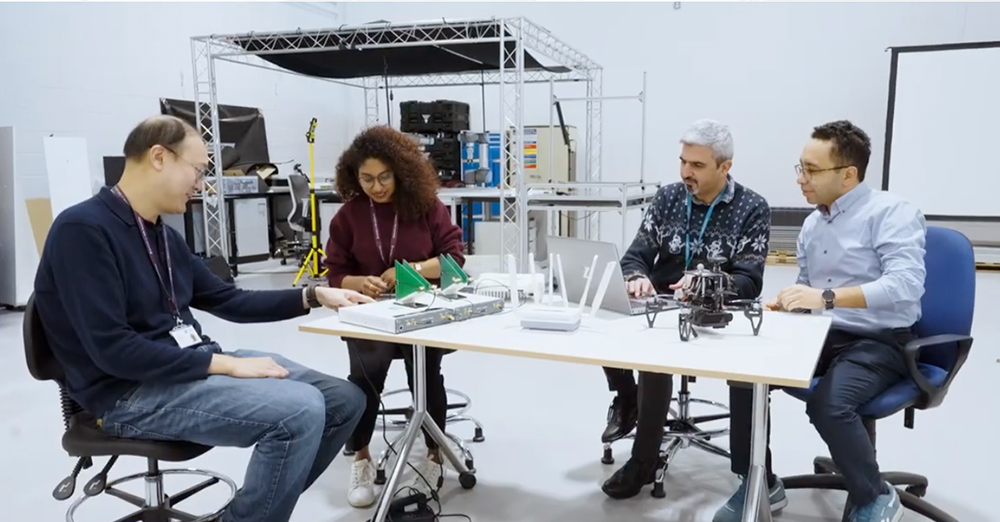
“In ORLANDO we move a step forward towards the AI-Native networks where we learn the user behaviour and train a scalable ML to predict network load and allocate network resources accordingly.” ~ Dr. Hamed Ahmadi, Reader in Digital Engineering
To connect directly with the ORLANDO researchers, register your here.
See ORLANDO – The Intelligent Load Balancing xApp from University of York
Links, Papers & Further Resources
- Scalable machine learning-based approaches for energy saving in densely deployed Open RAN – https://arxiv.org/pdf/2604.00201
- Unlocking Efficient Connectivity: Advanced AI-Driven Planning for Multi-Hop IAB Networks – https://ieeexplore.ieee.org/stamp/stamp.jsp?arnumber=11426753
- Interpretable Attention-Based Multi-Agent PPO for Latency Spike Resolution in 6G RAN Slicing – https://arxiv.org/pdf/2602.11076
- Green O-RAN Operation: a Modern ML-Driven Network Energy Consumption Optimisation – https://arxiv.org/pdf/2512.07006