
HASC News
SMALLER, CHEAPER & GREENER MOBILE NETWORK HARDWARE
Mobile networks are quietly one of the most energy-intensive parts of our digital infrastructure. The towers, antennas, and radio units that keep us connected consume enormous amounts of power – and much of that consumption comes not from inefficiency in the obvious sense, but from a fundamental design problem that the industry has largely accepted as unavoidable. That is, until now.
The Problem: Duplicated Hardware, Multiplied Costs
Modern mobile networks operate across multiple frequency bands simultaneously. A single base station might need to serve users on a mid-band 5G frequency while also handling a separate private network on a different band. The way this has traditionally been handled is straightforward, but wasteful: build a separate radio unit for each band.
Two bands. Two sets of hardware. Two sets of power draws. Two sets of components to manufacture, deploy, and maintain.
Multiply that across thousands of base stations and the cost and carbon implications become significant. It’s one of the reasons that energy expenditure is a major operational burden for mobile network operators – and a genuine obstacle to meeting net-zero targets.
The question the University of Sheffield’s Wireless Communication Systems team set out to answer through the YO-RAN project was simple: why are we building two of everything, and can we stop doing that?
The Solution: One Radio Unit, Two Bands, a Single Shared Architecture
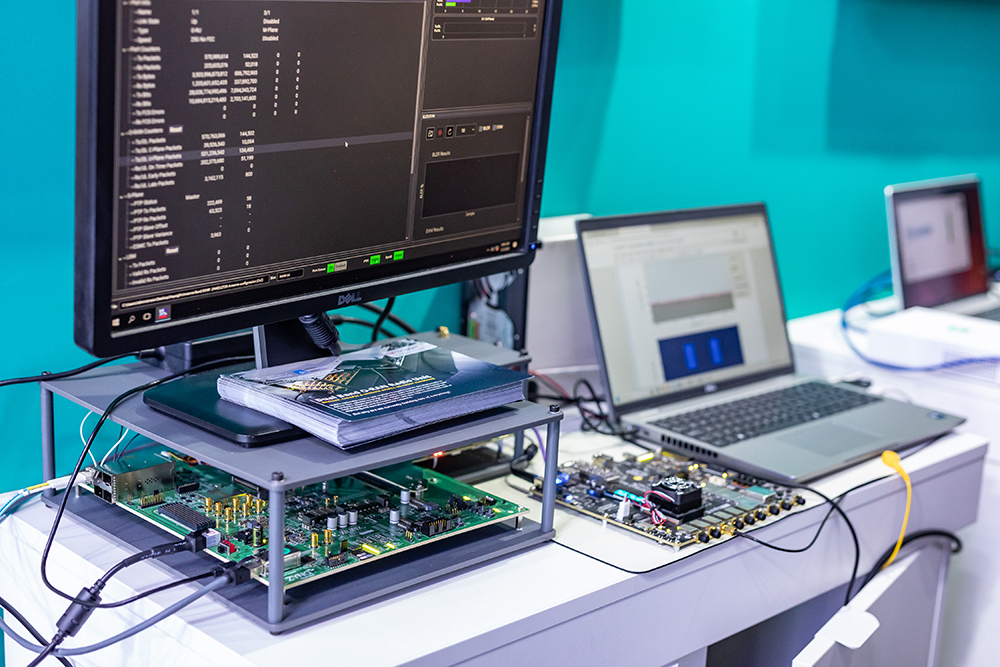
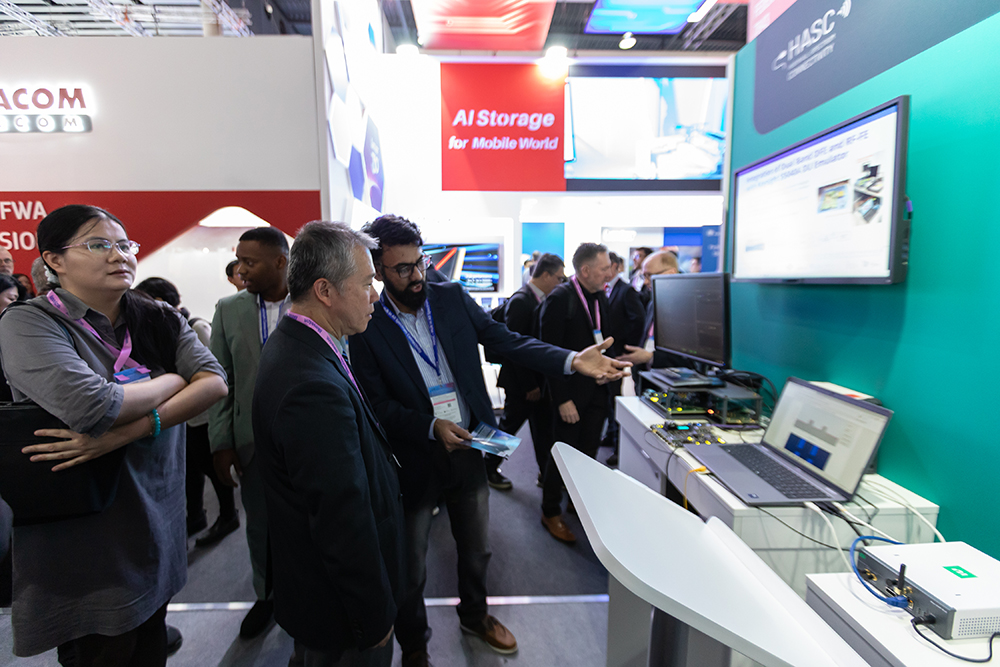
Demonstrated at Mobile World Congress 2026 in Barcelona, the Dual Band Open-RAN radio unit represents a significant step towards a leaner and more efficient model for mobile network hardware.
The core innovation is architectural. Rather than pairing two independent radio chains – each with its own digital-to-analogue converter (DAC), analogue-to-digital converter (ADC), and RF components – the Sheffield team has developed a radio unit in which two frequency bands share a single RF chain. Specifically, the prototype operates across the n78 (3.5 GHz) and n77-upper (4.005 GHz) frequency bands, which together cover both public 5G networks and private enterprise deployments.
The digital front-end (DFE) is built on the AMD/Xilinx ZCU670 RFSoC platform, a high-performance reconfigurable system-on-chip that handles two component carriers simultaneously. On the analogue side, a custom-designed RF front-end board manages both bands through shared circuitry – a single low-noise amplifier (LNA) for the receiver, and a shared transmit path enhanced with digital predistortion (DPD).
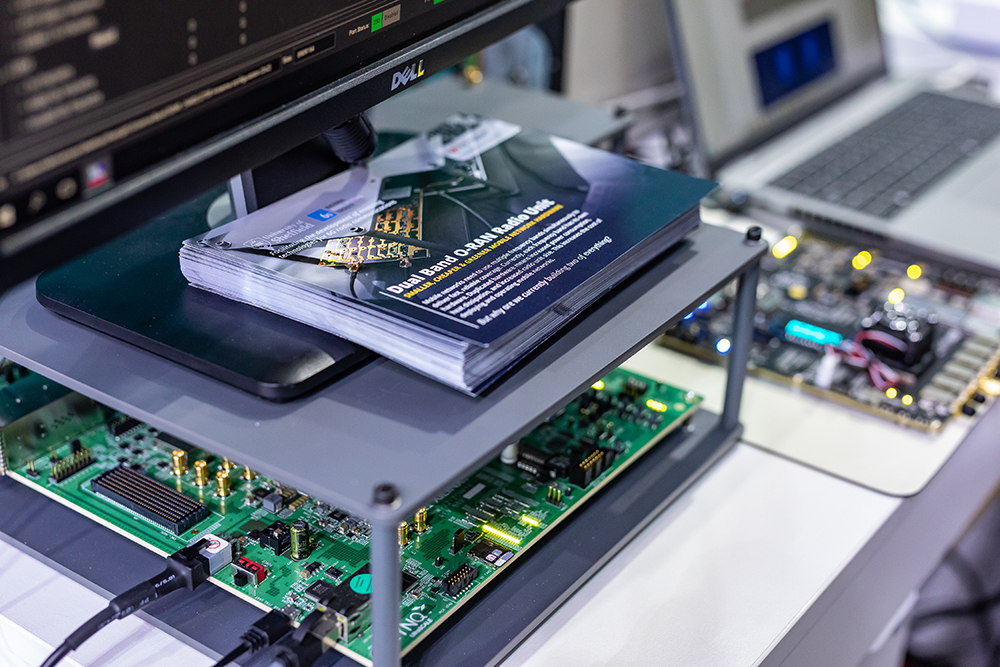
That last technique is worth pausing on. Power amplifiers are most efficient when operating close to their maximum output – but pushing them too hard distorts the signal. DPD corrects for that distortion digitally, allowing the amplifier to run at a more efficient operating point without sacrificing signal quality. It’s a meaningful contributor to reducing the overall power consumption of the unit. The result: fewer components, lower power draw, and a smaller physical footprint – without sacrificing performance.
Validated Against Industry Standards
Innovation in radio hardware only exists so far without interoperability. Open RAN – the disaggregated, vendor-neutral architecture that is reshaping how mobile networks are built – requires radio units to communicate with distributed units (DUs) from different suppliers using standardised interfaces.
The Sheffield prototype has been validated using the Keysight S5040A Distributed Unit Emulator, demonstrating compliance with the O-RAN 7.2x fronthaul interface specification. End-to-end testing confirmed that the dual band unit can exchange 5G NR signals cleanly across both frequency bands, with fronthaul synchronisation and RF chain performance verified across the full signal path.
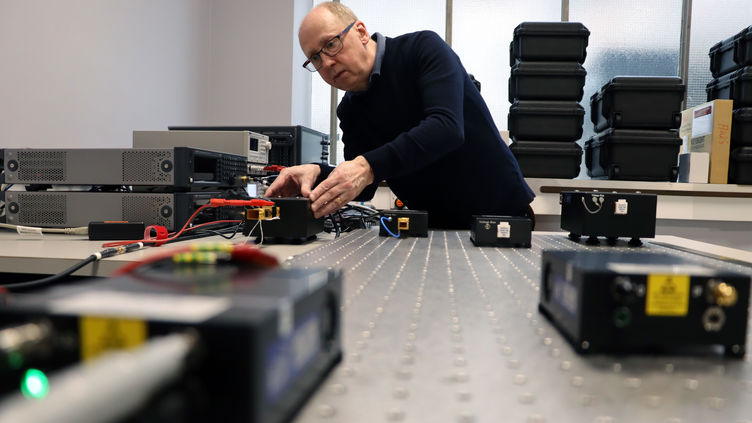

This matters for the commercialisation pathway. A radio unit that works in a lab is one thing; a radio unit that can plug into a real Open-RAN ecosystem and interoperate with third-party DUs is quite another.
“The opportunity to present our neutral host, dual band, O-RAN radio unit technology at MWC was immensely valuable. The realisation of two concurrent, independent frequency bands on a unique single RF architecture yields significant cost and energy consumption savings. MWC and the HASC Hub provided the ideal environment to showcase this advanced radio technology, supporting our pathway to commercialisation and exploitation.”
~ Professor Timothy O’Farrell FREng,
Why This Matters Beyond the Lab
The implications of this work extend well beyond hardware engineering.
For network operators, a single compact radio unit covering two bands means lower capital expenditure on hardware, reduced installation complexity, and lower energy bills over the lifetime of the deployment. For operators running neutral-host models – where a single piece of infrastructure serves multiple operators or use cases – the ability to allocate the two bands independently is particularly powerful.
For vendors and the Open-RAN supply chain, simplified radio designs with fewer duplicated components reduce manufacturing costs and open up opportunities to deliver more competitive, sustainable products into a market that is increasingly cost-sensitive.
For society and the environment, the arithmetic is straightforward: lower-power radio units, deployed at scale across national and international networks, contribute significantly to reducing the energy footprint of mobile connectivity. At a time when both governments and operators are under pressure to demonstrate credible progress toward net-zero, such hardware-level efficiency gains matter.
The YO-RAN project, funded by DSIT, is one of a portfolio of research programmes housed within Sheffield’s National 6G Radio Systems Facility, a £2.4m testbed that provides one of the UK’s most capable platforms for physical layer 6G research.
What Comes Next
The prototype demonstrated at MWC is an early-stage proof of concept designed to establish that the architecture works and to inform the next phase of design refinement. Characterisation results from the prototype are now being used to optimise the hardware toward higher-TRL versions with improved RF performance and tighter integration.
The team is actively seeking research collaborators and industry partners to help accelerate that journey from prototype to deployment. If you’re working in network infrastructure, Open-RAN, spectrum policy, or sustainable connectivity and want to explore what a partnership might look like, get in touch.
The YO-RAN project is funded by the Department for Science, Innovation and Technology (DSIT). The National 6G Radio Systems Facility is funded by EPSRC. The work was presented at Mobile World Congress 2026, Barcelona, with support from the Hub for Access to the Spectrum Community (HASC).