
HASC News
A World-First in Photonic Switching for 5G, 6G, and AI Infrastructure
Published in Photonics Research, Vol.†14, Issue 8, p. 3600 (2026) opg.optica.org/prj/fulltext.cfm?uri=prj-14-8-3600
There is a quiet assumption built into every network that has ever existed: that data must be read before it can be routed. A signal arrives, its header is decoded, a decision is made, and only then does the network act. Researchers at the University of Cambridge and the University of Bristol have demonstrated something that breaks this assumption entirely – and in doing so, they have opened the door to a fundamentally different kind of network.

Their system, built under the HASC project and now published in Photonics Research, doesn’t read the data at all. It operates on a pre-agreed, nanosecond-precision schedule – a world-first architecture, independently recognised by research funders in the United Kingdom, the United States, and the European Union, and accompanied by a joint patent application covering its applications across 5G, 6G, and AI data centre infrastructure.
A Problem Worth Solving
Every time you make a video call, use a connected device, or interact with an AI service, your data passes through a network that has to make thousands of routing decisions per second. The faster and more reliable those decisions are, the better your experience – and the more ambitious the applications those networks can support.
The challenge is architectural. Modern mobile networks – 5G today, 6G in active development – rely on a high-speed link between radio units at the edge and the processing infrastructure at the centre. This link, the ‘fronthaul,’ must route enormous volumes of data with timing accuracy down to the sub-microsecond level. Standards bodies like IEEE already require end-to-end latency below 100 microseconds for fronthaul-grade traffic. Denser networks and heavier application demands are pushing that ceiling to its absolute limits.

Electronic switches – the dominant technology for routing this traffic today – hit that ceiling in three specific ways: they introduce delay through store-and-forward processing, they add latency through buffering, and they create timing uncertainty through variable queuing. These are not just inconveniences. For time-critical applications – coordinated radio systems, remote surgery, autonomous vehicles, AI inference at scale – timing uncertainty at the microsecond level is an architectural barrier that electronic switching fundamentally cannot overcome.
“Conventional electronic switching often requires optical signals to be converted into electrical signals, processed, buffered, and then converted back into optical signals. This adds latency, energy cost, and timing uncertainty. Our aim was to show that an optical switch can keep data in the optical domain and route it according to a precise schedule, without needing to store, decode, or electronically process each burst.” Dr Tongyun Li, University of Cambridge
The challenge the HASC team set out to solve was not simply to build a faster switch. It was to build a system – switch, control electronics, timing infrastructure, and data framing – that could operate deterministically, at nanosecond scale, under realistic network conditions. Speed without determinism is not enough. What was needed was a network that could be trusted.
The Paradigm Shift: From Reactive to Predictive
Think of the difference between a traffic light that responds to sensors – waiting to detect a car before turning green – and one that runs on a pre-programmed schedule, timed to the second, that the whole system already knows. The first reacts. The second anticipates. Today’s networks react. This one anticipates.
Technically, this is the difference between event-driven and time-driven switching. Every existing optical switch (even nanosecond-capable ones) still relies on reading each incoming data burst: detecting a label or header, processing it, and then configuring the switch in response. This ‘reaction-based’ approach introduces irreducible timing uncertainty at every step. The team’s new system eliminates this entirely. Switch actions are pre-scheduled to nanosecond precision; no label is read, no header is decoded, no decision is made in real time. The network simply executes a plan it already has.
In technical terms: This is described in the paper as a ‘time-driven, label-free switching paradigm’ – a categorical departure from the event-driven architectures that dominate the field today.
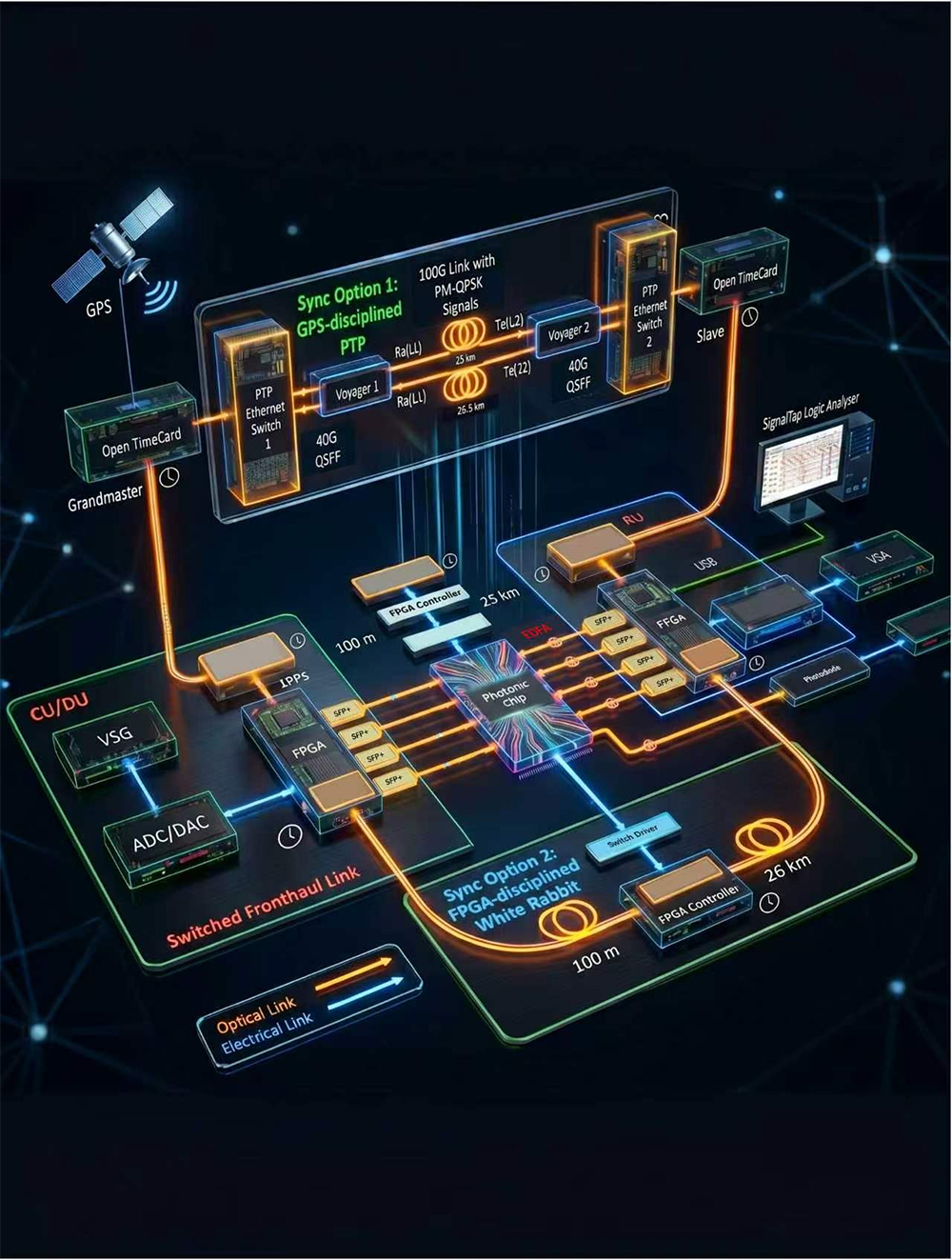
This is only possible because of the dual timing architecture at the heart of the system. Two independent synchronisation sources work in parallel, each suited to a different deployment scenario:
- GPS-disciplined Precision Time Protocol (PTP) – satellite-based timing that provides a nanosecond-accurate absolute time reference, deployable across large-scale and geographically distributed networks. In testing, this maintained timing stability below 114 nanoseconds across a real-world 25km multi-device transmission path.
- FPGA-disciplined White Rabbit synchronisation – an extension of PTP that adds sub-nanosecond phase tracking for ultra-precise local control. In testing, this achieved a peak-to-peak timing variation of just 170 picoseconds – 170 trillionths of a second – sustained over eight continuous hours of operation. Together, these two references give the system both the broad reach needed for real network deployment and the extraordinary local precision needed for nanosecond switching. PTP handles the network; White Rabbit handles the switch. Alone, neither would be sufficient.
“The turning point was when we could see the switching event and the recovered data frame lining up consistently in the FPGA measurements. That showed us the switch was not only fast in isolation, but fast, predictable, and stable enough to work as part of a real network system.” Dr Tongyun Li, University of Cambridge
The physical switch fabric itself is a world first. Built on a tri-layer silicon and silicon-nitride (Si-SiN-SiN) platform, it is the first electro-optic switch of its kind assembled in this multi-layer configuration. The three-dimensional architecture achieves a crossing-free photonic shuffle network – meaning optical signals at different routing paths never physically intersect, eliminating a key source of signal interference (crosstalk) that limits competing designs. The result is a switch with crosstalk below −40 dB and a device-level switching time of 5.9 nanoseconds.
In plain terms: multiple high-speed signals pass through the switch simultaneously without interfering with each other, and the physical switching action takes less than six nanoseconds. At the system level – including control electronics, timing, and data alignment – the total switch-on time is 33.4 nanoseconds.
Photonic Switching Technology: The Use Cases
The significance of this work is not really the speed. It is what that speed, combined with deterministic precision, makes possible for the first time. Four domains stand to be transformed.
1. Open RAN and 6G Mobile Networks
The mobile industry is actively building Open RAN – a more flexible, software-defined approach to mobile network architecture that allows components from different vendors to work together. This requires fronthaul links that can reconfigure dynamically, at sub-microsecond timescales, without buffering or packet loss. Electronic switching cannot reliably achieve this; photonic switching at nanosecond scale, with deterministic timing, can.
For 6G – where the expectation is coordinated radio systems, distributed sensing, and near-instantaneous responsiveness across dense urban deployments – this kind of physical-layer foundation is not optional. It is a prerequisite.
2. AI Data Centre Interconnects
As AI systems scale – larger models, larger clusters, more parallelism – the speed at which processors can communicate with each other becomes the limiting factor. Moving data between thousands of GPUs and specialised chips requires interconnects that are fast, deterministic, and energy efficient. Today, these interconnects are largely electronic, and they are already becoming bottlenecks.
Nanosecond photonic switching offers a route to lower-latency, more deterministic data-centre interconnects, with the potential for lower system-level energy consumption by reducing unnecessary electronic processing, buffering, and repeated optical-electrical-optical conversion.

A key longer-term opportunity is energy efficiency at infrastructure scale. Because the architecture is time-scheduled and label-free, data can be routed without repeatedly reading packet headers, making real-time routing decisions, or buffering traffic at every switching point. This reduces the amount of electronic processing required in the switching path and creates a route toward lower energy overhead in future fronthaul and data-centre networks.
Moving from microseconds to nanoseconds changes the type of traffic the switch can support – the network can potentially be reconfigured much more dynamically, with less idle time and lower latency.
3. Time-Critical Applications: Where Determinism Isn’t Optional
Remote surgery. Autonomous vehicles. Industrial automation. Coordinated drone systems. These are applications where a microsecond of unpredictability in the network is not just an inconvenience – it is a potential failure. What they require is not just a fast network, but a deterministic one: a network that delivers data not approximately on time, but precisely on time, every time.
This is exactly what the Cambridge & Bristol system demonstrates. The label-free, pre-scheduled architecture means that timing is not probabilistic – it is fixed.
4. Energy Efficiency at Infrastructure Scale
Because the system routes only active traffic, at precisely scheduled intervals, with no buffering or queuing overhead, it uses energy only for the connections that are live. There is no wasted capacity holding buffers open, processing headers, or maintaining idle paths.
For network operators managing dense urban deployments or large data centre fabrics, this traffic-adaptive efficiency is not a secondary benefit. As the scale of infrastructure grows to meet 6G and AI demand, the energy overhead of routing becomes one of the most significant operational costs. A switching architecture that is both faster and more energy-efficient is commercially, meaningful.
The Results
The system was experimentally validated under high-speed mobile signal conditions using commercial off-the-shelf transceivers, against real-world 3GPP quality standards. The table below summarises key measured results.
|
Metric |
Result |
Significance |
|
System switch-on latency |
33.4 nanoseconds |
~1,000x faster than commercial electronic switches |
|
System switch-off latency |
26.7 nanoseconds |
Consistent deterministic performance |
|
Timing variation (White Rabbit) |
170 picoseconds peak-to-peak |
Sustained over 8 hours – engineering-grade reliability |
|
Timing stability (GPS-PTP / 25km) |
<114 nanoseconds |
Across a real-world 25km multi-device transmission path |
|
Fronthaul data rate |
8.5 Gb/s |
Under 64-QAM and 256-QAM modulation |
|
RF dynamic range |
>39 dB, min EVM 1.09% |
Well within 3GPP specification – exceptional signal quality |
|
Optical link budget (1-to-1) |
>31 dB |
Unicast switching |
|
Optical link budget (1-to-4) |
>25 dB |
Multicast switching – one signal to four endpoints simultaneously |
|
Switch fabric |
8×8 ports |
Strictly non-blocking – any input to any output, without disrupting existing connections |
|
Device switching time |
5.9 ns rise / 2.8 ns fall |
Intrinsic photonic fabric speed |
Two results deserve particular attention. The 170-picosecond timing variation under White Rabbit synchronisation, sustained over eight hours of continuous operation. This is not peak performance under ideal conditions – it is a measure of sustained, engineering-grade reliability, and proving it is a real-world, deployable, technology.
The signal quality result is equally significant. The minimum error vector magnitude achieved was 1.09% – well below the 3GPP specification limit. The switch introduced no meaningful signal degradation across 20 switching paths simultaneously, under both 64-QAM and 256-QAM modulation. In practical terms: the switch is effectively transparent to the signals passing through it.
International Commitment
A piece of research is only as significant as the problem it solves – but one indicator of how seriously a problem is taken is who funds the effort to solve it. This work was supported by an international coalition of five major funders, spanning three continents, who independently assessed the challenge and committed resources to addressing it.
- UKRI-EPSRC HASC (EP/X040569/1) – the UK’s Future Communications Hub in All-Spectrum Connectivity, which funded the core Cambridge-Bristol collaboration
- US ARPA-E (ENLITENED Grant, DE-AR000843) – the US Advanced Research Projects Agency-Energy, which funds transformational technology with the potential to change energy and infrastructure at national scale. ARPA-E’s portfolio includes technologies that became GPS, the internet backbone, and advanced battery systems
- EU Horizon Europe – PUNCH (101070560) – a European research programme focused on next-generation photonic networks
- EU Horizon Europe – INSPIRE (101017088) – a further European programme addressing intelligent and sustainable network infrastructure
- UKRI-EPSRC QUDOS (EP/T028475/1) – focused on quantum-enabled and advanced optical communications systems
The fact that ARPA-E – an agency that does not fund incremental research – is backing this work alongside two separate EU Horizon programmes and two EPSRC grants signals something important: this is not a niche academic exercise. It is recognised, at the highest levels of international research funding, as a foundational technology challenge with real-world strategic significance.
The published paper in Photonics Research (Vol. 14, Issue 8, 2026) and the joint patent application covering fronthaul, AI data centre, and broader RAN applications together mark the team’s deliberate transition from research demonstration to deployable technology.
What This Means for Users
Technical breakthroughs in network infrastructure rarely make consumer headlines – but they shape the quality of every connected experience. The people who will eventually benefit from this research will, in the vast majority of cases, never know the switch exists. And that is precisely the point.
A network built on deterministic; nanosecond photonic switching is a network that gets out of the way. It doesn’t introduce delay, uncertainty, or degradation. It delivers. What that means in practice:
- More responsive mobile networks – better, more consistent performance in crowded environments: stadiums, city centres, transport hubs, anywhere today’s networks struggle under load
- Applications that couldn’t exist before – remote surgery, autonomous coordination, real-time industrial control: services that require the network to be not just fast, but guaranteed
- Faster, more efficient AI – reduced interconnect bottlenecks mean AI systems train faster, respond faster, and scale without the communication overhead that limits today’s largest clusters
- A foundation for 6G – the coordinated, distributed, ultra-low-latency radio architecture that 6G requires depends on exactly this kind of physical-layer capability
- More sustainable infrastructure – energy-efficient routing at scale means the networks of the future don’t just perform better; they do so with less waste
“Most users would never know the switch exists, but they could experience networks that feel more responsive, reliable, and capable of supporting demanding services. The underlying benefit is that the network becomes less of a limiting factor.” Dr Tongyun Li, University of Cambridge
What Comes Next
The team is clear about what remains to be done. The current system operates at 8.5 Gb/s – constrained by the available FPGA transceiver rate rather than the photonic fabric itself. The switch design is capable of supporting the higher 25 Gb/s eCPRI rates that next generation fronthaul will require, and this is a defined next step. Port scalability, tighter guard band allocation under White Rabbit precision, and closer integration between the switch control plane and network scheduling are all active areas of development.
None of this diminishes what has been demonstrated. The foundation – a real-time, deterministic, nanosecond photonic switching system with world-first architecture, validated against real network standards, sustained over hours of operation, and proven under realistic signal conditions – has now been bought to life. The next chapter is scaling it.
With the core technology now demonstrated, the team is looking to work with industry partners to further develop, validate, and commercialise the platform across future networking applications. If you are interested in speaking with the team, please get in touch hasc-enquiries@eng.ox.ac.uk
___________________________________________________________________________________________
Authors: Bohao Sun, Tongyun Li, Heyang Long, Peng Bao, Vaigai Nayaki Yokar, Sen Shen, Ziyao Zhang, Stefano Stracca, Shuangyi Yan, Jin Tao, Hanbing Li, Dimitra Simeonidou, Keren Bergman, Ian White, Richard Penty, Qixiang Cheng.
Published in: Photonics Research, Vol. 14, Issue 8, p. 3600 (2026) – opg.optica.org/prj/fulltext.cfm?uri=prj-14-8-3600
Funding: UKRI-EPSRC HASC (EP/X040569/1); US ARPA-E ENLITENED (DE-AR000843); EU Horizon Europe PUNCH (101070560); EU Horizon Europe INSPIRE (101017088); UKRI-EPSRC QUDOS (EP/T028475/1).
Never miss an update: https://share-eu1.hsforms.com/2gCQGRBmcRk2-IZ5gZ16iZA2ewoc2