Hub for All Spectrum Connectivity (HASC), a telecoms research project led by the University of Oxford, announced the addition of six new research projects to its evolving programme.
The initiative is set to add additional expertise to the hub, covering novel and innovative technologies that address core challenges in spectrum management, security and adaptivity.
“We are very pleased to be joined by our new partners and look forward to working with them. Together with our Federated Telecoms Hub partners, our focus is on ensuring the UK has a leading position in advanced connectivity, and these additional projects further strengthen our collaboration.” said Dominic O’Brien, Director, HASC
KEY FACTS:
New projects include the advancement of cutting-edge technologies such as:
Reconfigurable Intelligent Surfaces(RIS)– using smart reflective surfaces to boost and shape signals for faster, more reliable connectivity.
Rate-Splitting with SCMA– a smarter way of sharing spectrum so 6G can connect huge numbers of devices at once.
O-RAN Load Balancing– AI-driven tools to spread network traffic smoothly in busy areas for better efficiency.
Fibre–mmWave Convergence– trialling seamless fibre and wireless networks without costly signal conversions.
Successive Interference Cancellation– cancelling out signal interference so spectrum can be shared more flexibly.
Metasurface-enabled Curved Beams– creating curved light and radio beams in new ways for secure, efficient, and high-performance networks.
New Partners include The National Physical Laboratory (NPL), The Universities of Essex, York, Bangor, Bristol and Kings College London
Together, these projects are pushing the limits of how we connect – blending fibre and wireless, making better use of spectrum and finding smarter ways to keep networks secure, efficient, and reliable. The benefit for everyday life is simple: faster, greener, and more dependable connectivity that can keep up with everything from streaming to VR, smart homes and to future 6G and beyond.
About HASC
HASC’s focus is to optimally combine wired & wireless internet technologies to achieve end-to-end connectivity. It exists to enable the creation of future-ready networks that meet the growing demands of users and ensure the long-term viability of the UK’s evolving digital infrastructure.
The Hub is supported by substantial investment from the Engineering and Physical Sciences Research Council (EPSRC), part of UK Research and Innovation, and the UK Department of Science, Innovation and Technology. Grant References: EP/Y037197/1/ EP/X040569/1
Where Research Meets Industry: Accelerating the UK’s Future Networks
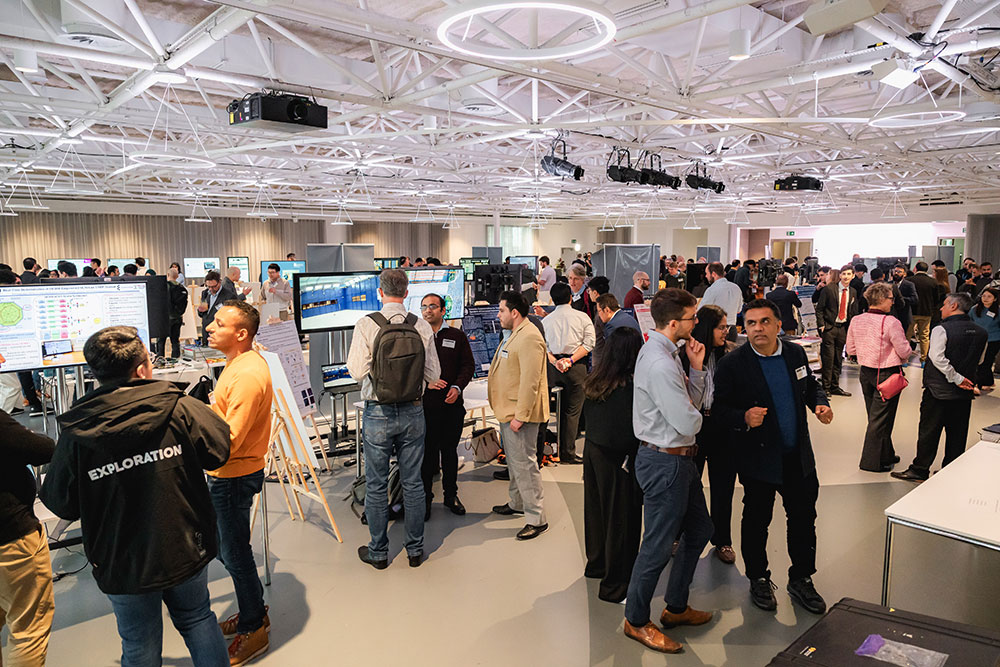
Busy exhibition floor at the Federated Telecoms Hubs Advanced Connectivity Showcase Science Museum London
On 1st of December, together with our partners at the Federated Telecoms Hubs (FTH), we brought the future of UK connectivity to the Science Museum, London. The Hubs came together to showcase. our cutting-edge scientific discoveries and high-TRL projects in a truly commercial setting. The FTH Advanced Connectivity Showcase was buzzing – a room full of conversations, new partnership opportunities and fresh ideas. The showcase brought together academic excellence, industry leaders, investors and government representatives with the aim of closing the gap between the lab and the real world… and it certainly didn’t disappoint.
As the global race for 6G and beyond intensifies our competitiveness will depend on converting research into real-world capability. And that demands collaboration. Events like this bring all the right stakeholders together from across the telecoms ecosystem and create the right conditions for meaningful connections and interaction. It was a packed itinerary – here are some of the highlights…
Maisie England, Head if Future Communications Research EPSRC
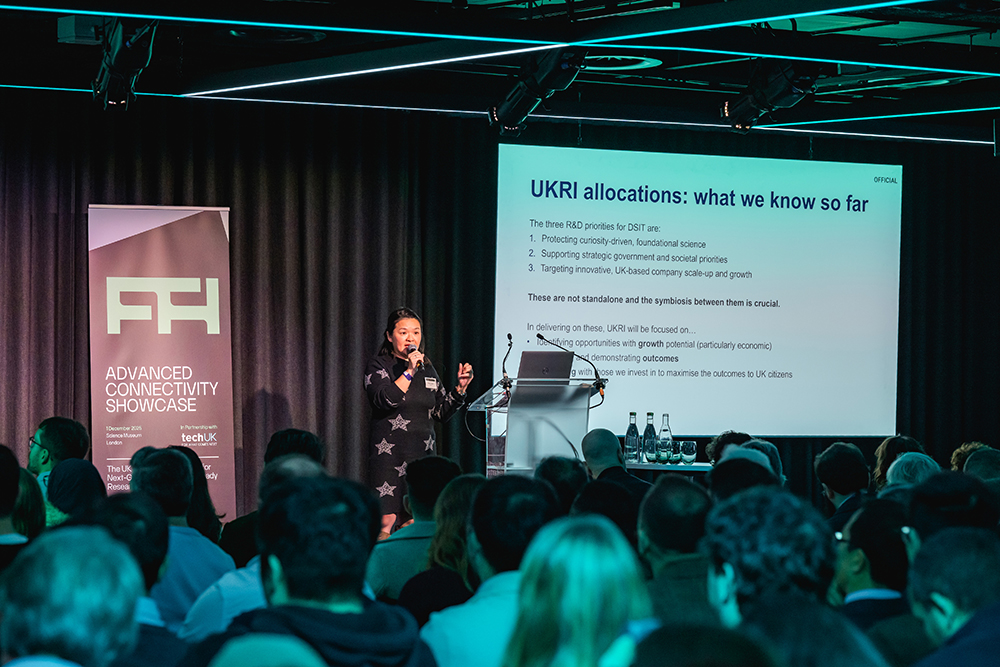
Maisie England Head of Future Communications Research at EPSRC Delivers her opening remarks at the FTH Advanced Connectivity Showcase
Maisie England from EPSRC joined us in the morning to highlight the vital role of international standards and collaboration, framing her talk around EPSRC’s mission “to advance knowledge, improve lives and drive growth.” She emphasised the need to protect curiosity-driven research while supporting our national priorities, boosting innovation & growth and securing the UK’s competitive advantage. As the funder of the Hubs,Maisie also outlined how EPSRC is working with us to fast-track innovation. This is vital in continuing to build on the UK’s strong research base and deliver commercial outcomes, open new markets, and gain deeper insight into industry needs–all vital for tomorrow’s technologies.
Keynote Speaker: Simon Clement, Director, Liberty Global
Keynote speaker, Simon Clement, Director Liberty Global, delivers his talk to the audience
Liberty Global is a major telecommunications and investment group that runs broadband, mobile, and TV businesses, supplying internet, video and phone services across the UK and Europe. Simon’s talk highlighted the UK’s strength as a bridge between research and enterprise, while noting that our spin-out rate still has room to grow. He spoke candidly about the realities of commercialising research and outlined his “7 Ts” for becoming an investable prospect:
Transformation – what problems are set to be solved
Technology – Being able to translate a highly technical idea into real life impact
Timing – Solve tomorrow’s problem, not todays
TAM – know your total available market and understanding the numbers
Traction – building customer pipeline
Team – importance of a strong founder team
10x – making sure the product has opportunity to scale and grow with attractive ROI
This valuable framework provided an exciting translation layer between the research world and the investment/commercial world – a major focus for the day. Simon also stressed the need for simpler IP management and closed with a gentle nudge to grow fast and not to be shy about ambition. His talk set the scene for the rest of the day, helping both sides understand each other’s expectations and how to work together more productively.
Showcasing UK Capability inAction
Across the exhibition floor, HASC researchers demonstrated technologies that are set to shape the future of standards, technologies and advanced networks. From advanced radio systems to experiments in AI-native infrastructure, the projects on display revealed the depth and breadth of UK innovation on all spectrum connectivity. Demonstrating market-ready or near-market tech, here is an overview of the amazing work HASC researchers exhibited at the Advanced Connectivity Showcase:
Advanced Radio Systems, Advanced PHY Layer Technologies & Spectrum Innovation
Imperial College London: Rate-Splitting Multiple Access (RSMA) for 6G – Next-Gen Wireless
Queen’s University Belfast: HASC related work at the Centre for Wireless Innovation
National Physical Laboratory:Exploring reconfigurable intelligent surface technology for optimal end-to-end connectivity
University of Bristol: SINATRA: Successive Interference Cancellation for Dynamic Spectrum Access
University of Bristol: GaN technology for resilience and energy efficient RF
Imperial College London: Reinforcement-Learning Beam Alignment for Base-Station Transmissions without CSI
University of Oxford: Resilience for Fiber-Wireless-Fiber Links Using Handovers
University of Sheffield: 6G Radio
University of Surrey: ML-Enabled RIS-Aided Communication
University of York: ORLANDO:O-RAN intelligent adaptive Load bAlaNcing and efficiency in highly Dense deplOyments
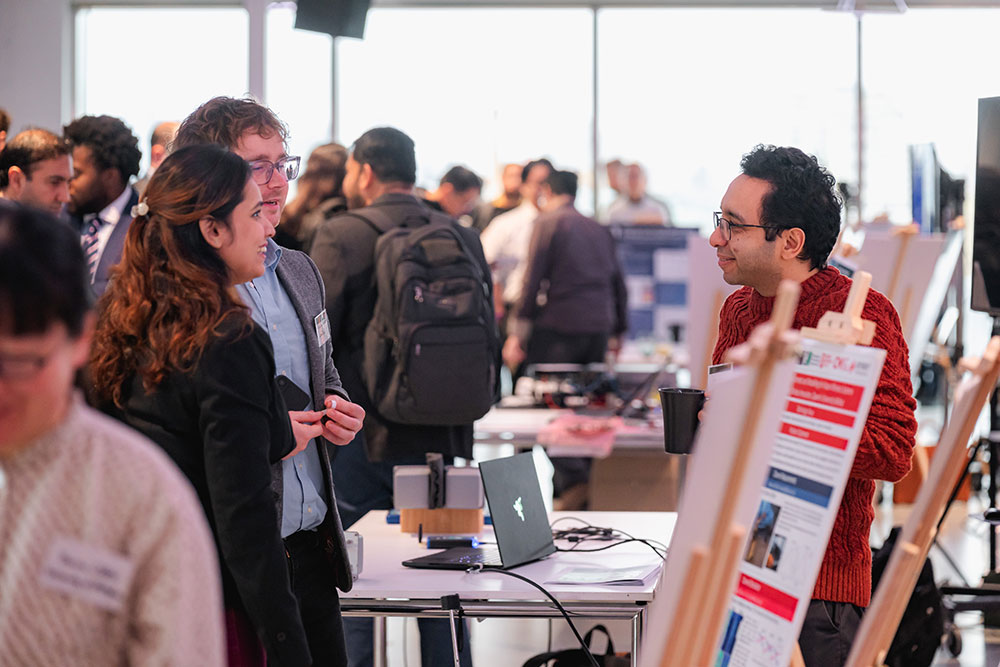
Hamed Ahmadi, University of York, discusses the ORLANDO project on the exhibition floor with delegates at the Advanced Connectivity Showcase
AI-Native Networks & Automation
University of Cambridge: Synchronous Photonic Switch Node: An Enabler for Future Low-Power, Low-Latency AI and RAN Networks
Optoelectronics Research Centre, University of Southampton: AI-Enhanced Chip-Scale Optical Monitoring: Smarter Network Diagnostics with SOAs
Smart Internet Lab, University of Bristol: mATRIC Digital Twin enabled Omniverse: Addressing intelligent wireless access and robot twin simulation for 6G applications
Emerging Technologies & Frontier Communication
University College London: Atmospheric turbulence emulator for free space optical communications
Security, Privacy & Trust
University of Liverpool – Securing Wi-Fi Connectivity: Wi-Fi Device Authentication Using Hardware Fingerprints
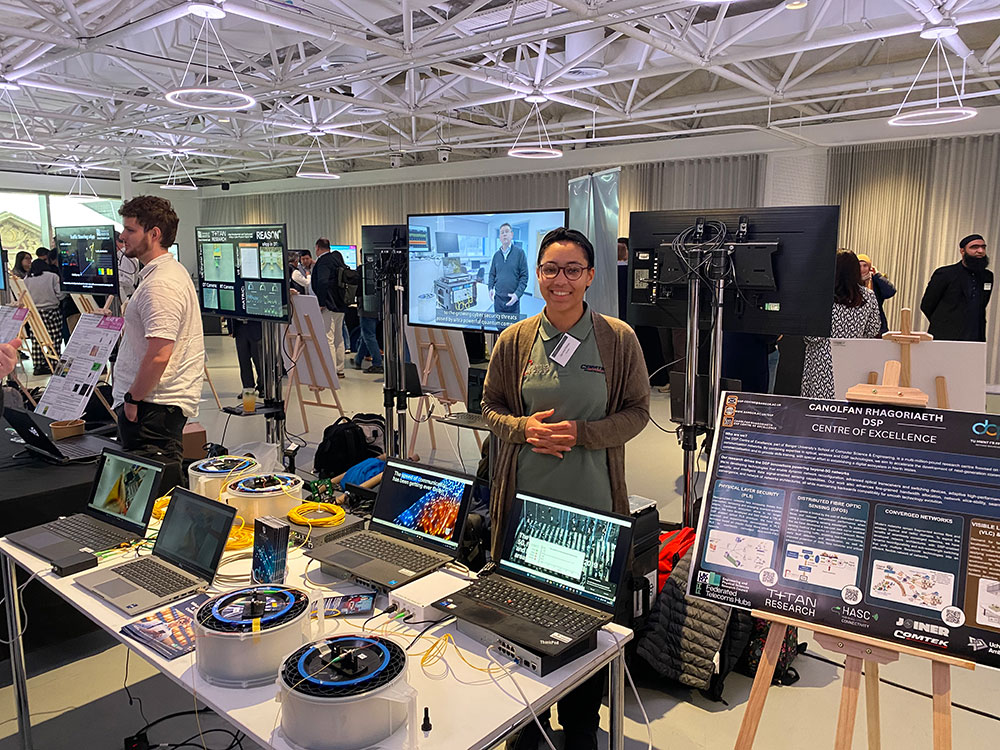
Bangor University (DSP Centre) – Plug-and-Play and Low-Cost Optical Repeater Prototypes
Jasmin Parkes from University of Bangor DSP Centre of Excellence
HASC At the Heart of The Connectivity Ecosystem
At HASC, our work isn’t just about producing excellent research. It’s about creating the right conditions for collaboration, helping industry engage early, and ensuring UK capability advances in a coordinated, strategic way. Bringing people together at events like the Advanced Connectivity Showcase is part of that mission.
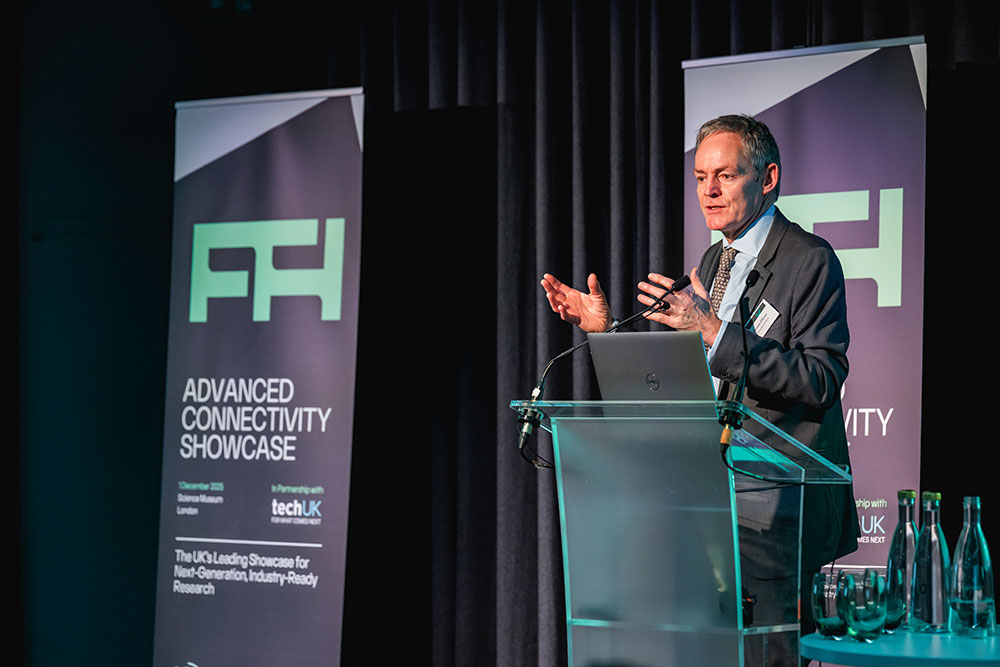
HASC Director Professor Dominic O’Brien, University of Oxford, addresses the audience at the Advance Connectivity Showcase outlining the aims of the HASC project
As per the HASC vision, future systems will need to optimise everything together, both wired and wireless infrastructure, capacity, reliability, sensing, latency, security, resilience and sustainability. That’s not something any single organisation can solve alone.This is why we believecollaboration is so essential. Academia brings depth of knowledge; industry brings commercial insight, scale and real-world use cases. Together, we can turn research into capability and capability into competitive advantage.
In Closing
As the doors closed on the Showcase, one thing was clear: the UK’s future networks depend on us doing much more of this – coming together, building relationships, sharing expertise, and building the technologies that will shape the next decade and beyond.The gap between discovery and deployment is where national advantage is won. And by bridging that gap, together, we can accelerate the UK’s path to secure, resilient and world-leading connectivity.
Want to stay involved? Keep an eye on our channels for updates, opportunities, and news from across the HASC community.
Even whilst 5G is still being rolled out worldwide, the groundwork for 6G is already being laid, with standards delivery expected around 2030. Data use worldwide is increasing exponentially (rising 15% in the UK between 2022 and 2023 alone), and this will only accelerate with the advent of emerging and future applications, such as autonomous vehicles, smart cities and immersive healthcare. This means that future telecommunications networks will need to deliver a step-change in capability, rather than incremental gains.
Introducing 6G is not only about faster downloads; the vision is for an extremely fast, ultra-reliable, low-latency, and intelligent communication fabric, achieving coverage everywhere and helping to close the digital divide. This network will also need the capacity to accommodate future 6G applications that demand extremely high data rates – and the terahertz (THz) spectrum is emerging as a promising candidate to extend standard technologies into new domains.
What is the THz Spectrum?
The THz spectrum spans frequencies from around 0.1 THz (100 GHz) to 10 THz, with corresponding wavelengths from about 3 mm down to 0.03 mm – shorter than microwaves, longer than mid-IR/near-IR, and overlapping the far-infrared. What makes THz particularly appealing is the enormous amount of bandwidth available. This allows for ultra-high-speed connectivity, potentially supporting wireless data rates exceeding 100 Gbps – well beyond what is possible with 5G or even advanced mmWave.
Because of this, the THz band has become an active 6G research topic, with engineers and scientists worldwide exploring how it could reshape future mobile networks.
Faster data transmission (lower latency): Because THz provides an exceptionally large bandwidth, each data symbol can be transmitted over a much shorter duration, reducing overall latency. In addition, the very high data rates available at THz frequencies make it possible to send information without compressing it first – avoiding the extra processing time needed for compression and decompression in lower-bandwidth systems.
Closer integration with optical fibre: THz signals can be generated directly from optical signals by photomixing (where THz radiation is generated by combining two different laser signals on a high-speed optical detector). This makes it possible to create seamless hybrid fibre-wireless networks, combining the reach of optical fibre with the flexibility of wireless.
Advanced sensing capabilities: Thanks to their very short wavelengths and unique interactions with different materials, THz signals can be used not just for data transfer but also for high-resolution imaging and sensing – enabling applications from gesture recognition to integrated communication-and-radar systems.
These qualities position THz as an enabler of the capabilities policymakers have identified for 6G: intelligence, sustainability, security and universal access.
Utilising the THz spectrum in 6G could also unlock new innovations, including:
Immersive communication: Holographic conferencing, volumetric (3D) video and ultra-realistic augmented or virtual reality will demand ultra-high-speed connectivity with millisecond latency.
Data centre connectivity: Short-range high-speed comms using THz links could replace some fibre interconnects, reducing cabling complexity and cost.
Wireless backhaul: THz could provide fibre-like performance in places where laying fibre is impractical.
‘Smart’ applications and automation: By enabling high-resolution sensing, THz could support applications that include ‘Internet of Things,’ ‘smart’ factories and cities, and autonomous driving – areas that require precise motion tracking and/or machine coordination.
Robotics: Highly-responsive connectivity and integrated sensing could enable advanced robotics, including for healthcare, surgery and industry.
Barriers and Challenges in THz
Despite its promise, THz communications face steep barriers:
Severe propagation loss: THz signals attenuate rapidly in free space and are highly vulnerable to obstacles and environmental conditions.
Short transmission ranges: Links are typically limited to tens of metres without special equipment.
Regulatory uncertainty: Unlike microwaves and mmWave, which already have clearly defined and regulated spectrum allocations, the THz band still lacks globally agreed allocations for communications.
Device engineering: Generating and detecting THz efficiently requires specialised photonic and electronic devices that are still under development.
HASC Research into THz
To address these challenges, the Hub in All Spectrum Connectivity (HASC)’s THz research portfolio includes device development, optical-wireless integration and network modelling. Some highlights include:
Dark fibre experiments: HASC is investigating the potential of the THz spectrum using the UK’s EPSRC-funded ‘dark fibre’ network. This gives researchers hundreds of kilometres of real-world fibre to test new ideas, such as carrying and regenerating THz signals over long distances to explore how to link high-speed fibre networks with future THz wireless systems.
Device innovation: A promising technology is the UTC-PD (Uni-Travelling Carrier Photodiode), which converts optical signals into electrical / THz signals. HASC researchers are developing new ways of housing and integrating ultra-fast UTC-PDs, so they deliver more power, handle higher speeds and work more reliably in THz transmitters and receivers.
As the 2030 target for standardising 6G rapidly approaches, the next few years will see THz research move from controlled experiments to field-ready prototypes, allowing researchers to assess how THz can fit into the next-generation communications network. If the attractive qualities of THz are to support the vision for a robust, flexible future telecommunications network, it is vital that the challenges of THz propagation, regulation and device design are addressed.
Ultimately, no single technology will deliver 6G: instead, it is likely this will dynamically integrate THz, mmWave, microwave and legacy frequencies to balance coverage, mobility and capacity. For industry professionals and academics alike, the message is clear: keep watching the terahertz 6G research space. The next generation of wireless is being built now, and the exciting capabilities of THz are starting to take shape.
Want to stay involved? Keep an eye on our channels for updates, opportunities, and news from across the HASC community.