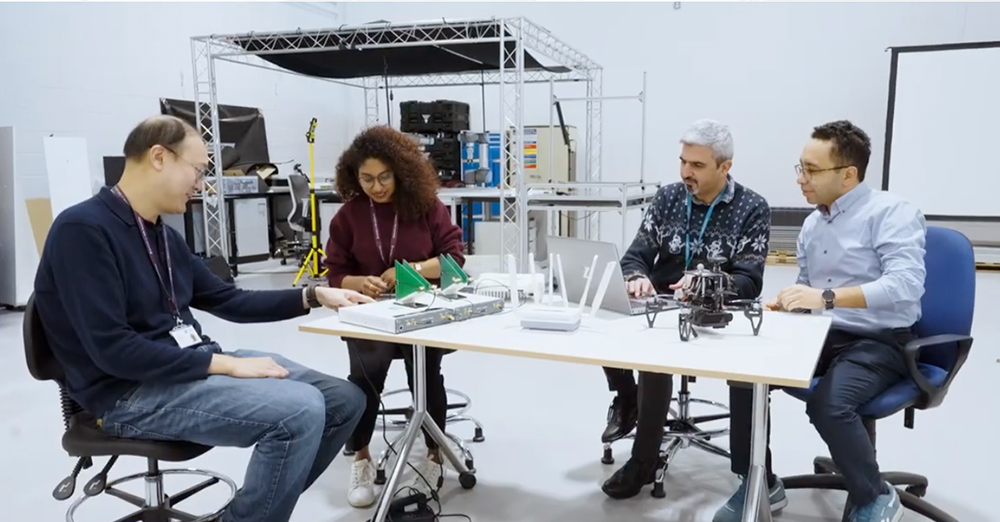

The Network That Knows What’s Coming

A World-First in Photonic Switching for 5G, 6G, and AI Infrastructure

Published in Photonics Research, Vol.†14, Issue 8, p. 3600 (2026) opg.optica.org/prj/fulltext.cfm?uri=prj-14-8-3600

There is a quiet assumption built into every network that has ever existed: that data must be read before it can be routed. A signal arrives, its header is decoded, a decision is made, and only then does the network act. Researchers at the University of Cambridge and the University of Bristol have demonstrated something that breaks this assumption entirely – and in doing so, they have opened the door to a fundamentally different kind of network.
Their system, built under the HASC project and now published in Photonics Research, doesn’t read the data at all. It operates on a pre-agreed, nanosecond-precision schedule – a world-first architecture, independently recognised by research funders in the United Kingdom, the United States, and the European Union, and accompanied by a joint patent application covering its applications across 5G, 6G, and AI data centre infrastructure.

A Problem Worth Solving

Every time you make a video call, use a connected device, or interact with an AI service, your data passes through a network that has to make thousands of routing decisions per second. The faster and more reliable those decisions are, the better your experience – and the more ambitious the applications those networks can support.

The challenge is architectural. Modern mobile networks – 5G today, 6G in active development – rely on a high-speed link between radio units at the edge and the processing infrastructure at the centre. This link, the ‘fronthaul,’ must route enormous volumes of data with timing accuracy down to the sub-microsecond level. Standards bodies like IEEE already require end-to-end latency below 100 microseconds for fronthaul-grade traffic. Denser networks and heavier application demands are pushing that ceiling to its absolute limits.

Electronic switches – the dominant technology for routing this traffic today – hit that ceiling in three specific ways: they introduce delay through store-and-forward processing, they add latency through buffering, and they create timing uncertainty through variable queuing. These are not just inconveniences. For time-critical applications – coordinated radio systems, remote surgery, autonomous vehicles, AI inference at scale – timing uncertainty at the microsecond level is an architectural barrier that electronic switching fundamentally cannot overcome.

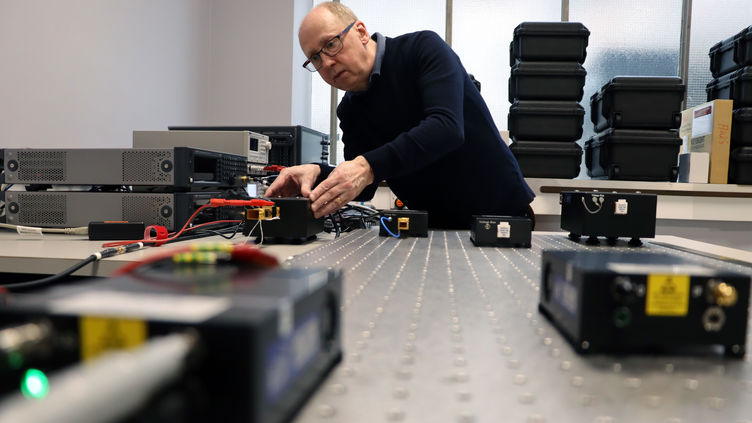
“Conventional electronic switching often requires optical signals to be converted into electrical signals, processed, buffered, and then converted back into optical signals. This adds latency, energy cost, and timing uncertainty. Our aim was to show that an optical switch can keep data in the optical domain and route it according to a precise schedule, without needing to store, decode, or electronically process each burst.” Dr Tongyun Li, University of Cambridge

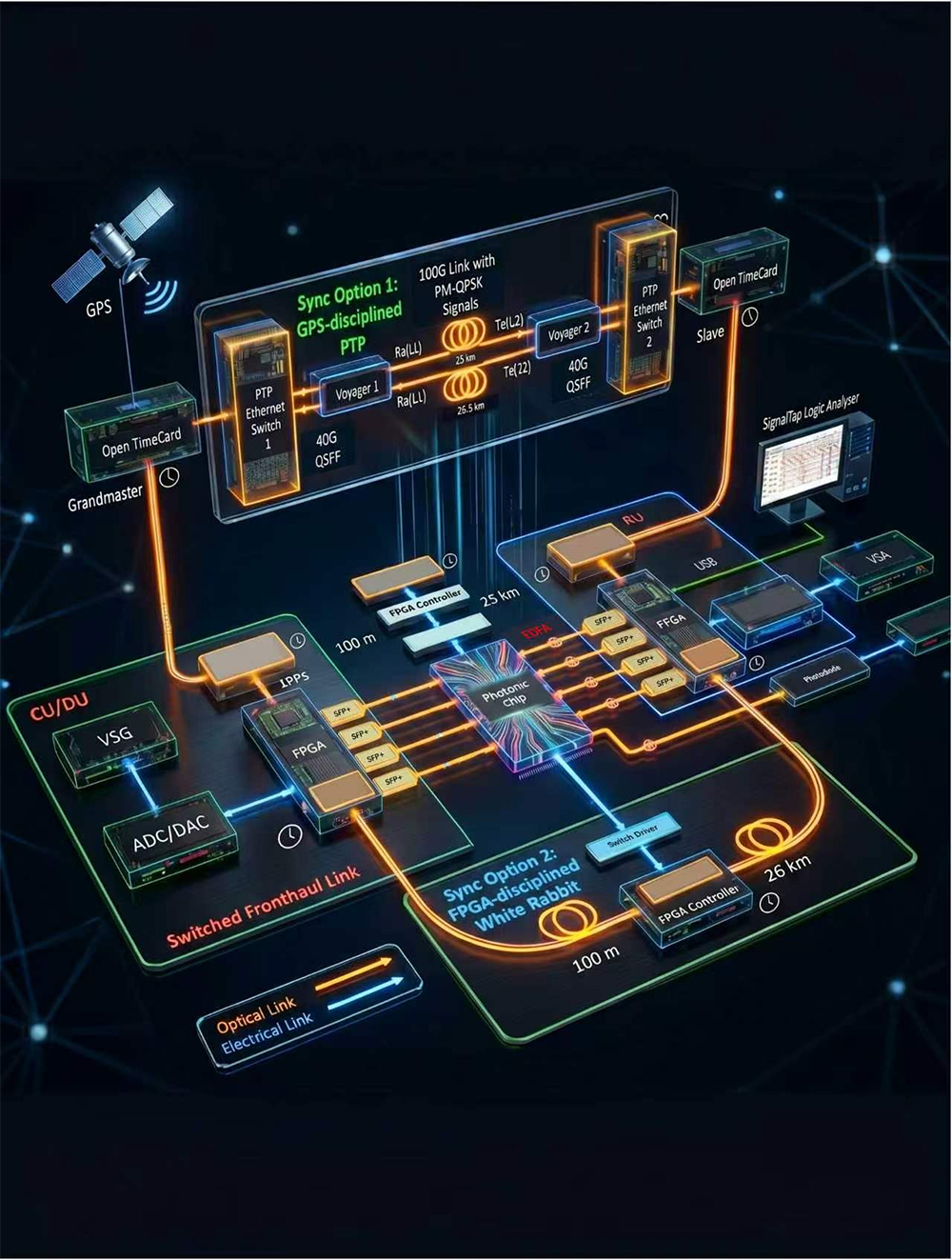
The challenge the HASC team set out to solve was not simply to build a faster switch. It was to build a system – switch, control electronics, timing infrastructure, and data framing – that could operate deterministically, at nanosecond scale, under realistic network conditions. Speed without determinism is not enough. What was needed was a network that could be trusted.

The Paradigm Shift: From Reactive to Predictive

Think of the difference between a traffic light that responds to sensors – waiting to detect a car before turning green – and one that runs on a pre-programmed schedule, timed to the second, that the whole system already knows. The first reacts. The second anticipates. Today’s networks react. This one anticipates.

Technically, this is the difference between event-driven and time-driven switching. Every existing optical switch (even nanosecond-capable ones) still relies on reading each incoming data burst: detecting a label or header, processing it, and then configuring the switch in response. This ‘reaction-based’ approach introduces irreducible timing uncertainty at every step. The team’s new system eliminates this entirely. Switch actions are pre-scheduled to nanosecond precision; no label is read, no header is decoded, no decision is made in real time. The network simply executes a plan it already has.

In technical terms: This is described in the paper as a ‘time-driven, label-free switching paradigm’ – a categorical departure from the event-driven architectures that dominate the field today.

This is only possible because of the dual timing architecture at the heart of the system. Two independent synchronisation sources work in parallel, each suited to a different deployment scenario:

  1. GPS-disciplined Precision Time Protocol (PTP) – satellite-based timing that provides a nanosecond-accurate absolute time reference, deployable across large-scale and geographically distributed networks. In testing, this maintained timing stability below 114 nanoseconds across a real-world 25km multi-device transmission path.
  2. FPGA-disciplined White Rabbit synchronisation – an extension of PTP that adds sub-nanosecond phase tracking for ultra-precise local control. In testing, this achieved a peak-to-peak timing variation of just 170 picoseconds – 170 trillionths of a second – sustained over eight continuous hours of operation. Together, these two references give the system both the broad reach needed for real network deployment and the extraordinary local precision needed for nanosecond switching. PTP handles the network; White Rabbit handles the switch. Alone, neither would be sufficient.

“The turning point was when we could see the switching event and the recovered data frame lining up consistently in the FPGA measurements. That showed us the switch was not only fast in isolation, but fast, predictable, and stable enough to work as part of a real network system.” Dr Tongyun Li, University of Cambridge

The physical switch fabric itself is a world first. Built on a tri-layer silicon and silicon-nitride (Si-SiN-SiN) platform, it is the first electro-optic switch of its kind assembled in this multi-layer configuration. The three-dimensional architecture achieves a crossing-free photonic shuffle network – meaning optical signals at different routing paths never physically intersect, eliminating a key source of signal interference (crosstalk) that limits competing designs. The result is a switch with crosstalk below −40 dB and a device-level switching time of 5.9 nanoseconds.

In plain terms: multiple high-speed signals pass through the switch simultaneously without interfering with each other, and the physical switching action takes less than six nanoseconds. At the system level – including control electronics, timing, and data alignment – the total switch-on time is 33.4 nanoseconds.

Photonic Switching Technology: The Use Cases

The significance of this work is not really the speed. It is what that speed, combined with deterministic precision, makes possible for the first time. Four domains stand to be transformed.

1. Open RAN and 6G Mobile Networks

The mobile industry is actively building Open RAN – a more flexible, software-defined approach to mobile network architecture that allows components from different vendors to work together. This requires fronthaul links that can reconfigure dynamically, at sub-microsecond timescales, without buffering or packet loss. Electronic switching cannot reliably achieve this; photonic switching at nanosecond scale, with deterministic timing, can.

For 6G – where the expectation is coordinated radio systems, distributed sensing, and near-instantaneous responsiveness across dense urban deployments – this kind of physical-layer foundation is not optional. It is a prerequisite.

2. AI Data Centre Interconnects

As AI systems scale – larger models, larger clusters, more parallelism – the speed at which processors can communicate with each other becomes the limiting factor. Moving data between thousands of GPUs and specialised chips requires interconnects that are fast, deterministic, and energy efficient. Today, these interconnects are largely electronic, and they are already becoming bottlenecks.

Nanosecond photonic switching offers a route to lower-latency, more deterministic data-centre interconnects, with the potential for lower system-level energy consumption by reducing unnecessary electronic processing, buffering, and repeated optical-electrical-optical conversion.

A key longer-term opportunity is energy efficiency at infrastructure scale. Because the architecture is time-scheduled and label-free, data can be routed without repeatedly reading packet headers, making real-time routing decisions, or buffering traffic at every switching point. This reduces the amount of electronic processing required in the switching path and creates a route toward lower energy overhead in future fronthaul and data-centre networks.

Moving from microseconds to nanoseconds changes the type of traffic the switch can support – the network can potentially be reconfigured much more dynamically, with less idle time and lower latency.

3. Time-Critical Applications: Where Determinism Isn’t Optional

Remote surgery. Autonomous vehicles. Industrial automation. Coordinated drone systems. These are applications where a microsecond of unpredictability in the network is not just an inconvenience – it is a potential failure. What they require is not just a fast network, but a deterministic one: a network that delivers data not approximately on time, but precisely on time, every time.

This is exactly what the Cambridge & Bristol system demonstrates. The label-free, pre-scheduled architecture means that timing is not probabilistic – it is fixed.

4. Energy Efficiency at Infrastructure Scale

Because the system routes only active traffic, at precisely scheduled intervals, with no buffering or queuing overhead, it uses energy only for the connections that are live. There is no wasted capacity holding buffers open, processing headers, or maintaining idle paths.

For network operators managing dense urban deployments or large data centre fabrics, this traffic-adaptive efficiency is not a secondary benefit. As the scale of infrastructure grows to meet 6G and AI demand, the energy overhead of routing becomes one of the most significant operational costs. A switching architecture that is both faster and more energy-efficient is commercially, meaningful. 

The Results

The system was experimentally validated under high-speed mobile signal conditions using commercial off-the-shelf transceivers, against real-world 3GPP quality standards. The table below summarises key measured results.

Metric

Result

Significance

System switch-on latency

33.4 nanoseconds

~1,000x faster than commercial electronic switches

System switch-off latency

26.7 nanoseconds

Consistent deterministic performance

Timing variation (White Rabbit)

170 picoseconds peak-to-peak

Sustained over 8 hours – engineering-grade reliability

Timing stability (GPS-PTP / 25km)

<114 nanoseconds

Across a real-world 25km multi-device transmission path

Fronthaul data rate

8.5 Gb/s

Under 64-QAM and 256-QAM modulation

RF dynamic range

>39 dB, min EVM 1.09%

Well within 3GPP specification – exceptional signal quality

Optical link budget (1-to-1)

>31 dB

Unicast switching

Optical link budget (1-to-4)

>25 dB

Multicast switching – one signal to four endpoints simultaneously

Switch fabric

8×8 ports

Strictly non-blocking – any input to any output, without disrupting existing connections

Device switching time

5.9 ns rise / 2.8 ns fall

Intrinsic photonic fabric speed

Two results deserve particular attention. The 170-picosecond timing variation under White Rabbit synchronisation, sustained over eight hours of continuous operation. This is not peak performance under ideal conditions – it is a measure of sustained, engineering-grade reliability, and proving it is a real-world, deployable, technology.

The signal quality result is equally significant. The minimum error vector magnitude achieved was 1.09% – well below the 3GPP specification limit. The switch introduced no meaningful signal degradation across 20 switching paths simultaneously, under both 64-QAM and 256-QAM modulation. In practical terms: the switch is effectively transparent to the signals passing through it.
International Commitment

A piece of research is only as significant as the problem it solves – but one indicator of how seriously a problem is taken is who funds the effort to solve it. This work was supported by an international coalition of five major funders, spanning three continents, who independently assessed the challenge and committed resources to addressing it.

  • UKRI-EPSRC HASC (EP/X040569/1) – the UK’s Future Communications Hub in All-Spectrum Connectivity, which funded the core Cambridge-Bristol collaboration
  • US ARPA-E (ENLITENED Grant, DE-AR000843) – the US Advanced Research Projects Agency-Energy, which funds transformational technology with the potential to change energy and infrastructure at national scale. ARPA-E’s portfolio includes technologies that became GPS, the internet backbone, and advanced battery systems
  • EU Horizon Europe – PUNCH (101070560) – a European research programme focused on next-generation photonic networks
  • EU Horizon Europe – INSPIRE (101017088) – a further European programme addressing intelligent and sustainable network infrastructure
  • UKRI-EPSRC QUDOS (EP/T028475/1) – focused on quantum-enabled and advanced optical communications systems

The fact that ARPA-E – an agency that does not fund incremental research – is backing this work alongside two separate EU Horizon programmes and two EPSRC grants signals something important: this is not a niche academic exercise. It is recognised, at the highest levels of international research funding, as a foundational technology challenge with real-world strategic significance.

The published paper in Photonics Research (Vol. 14, Issue 8, 2026) and the joint patent application covering fronthaul, AI data centre, and broader RAN applications together mark the team’s deliberate transition from research demonstration to deployable technology.

What This Means for Users

Technical breakthroughs in network infrastructure rarely make consumer headlines – but they shape the quality of every connected experience. The people who will eventually benefit from this research will, in the vast majority of cases, never know the switch exists. And that is precisely the point.

A network built on deterministic; nanosecond photonic switching is a network that gets out of the way. It doesn’t introduce delay, uncertainty, or degradation. It delivers. What that means in practice:

  • More responsive mobile networks – better, more consistent performance in crowded environments: stadiums, city centres, transport hubs, anywhere today’s networks struggle under load
  • Applications that couldn’t exist before – remote surgery, autonomous coordination, real-time industrial control: services that require the network to be not just fast, but guaranteed
  • Faster, more efficient AI – reduced interconnect bottlenecks mean AI systems train faster, respond faster, and scale without the communication overhead that limits today’s largest clusters
  • A foundation for 6G – the coordinated, distributed, ultra-low-latency radio architecture that 6G requires depends on exactly this kind of physical-layer capability
  • More sustainable infrastructure – energy-efficient routing at scale means the networks of the future don’t just perform better; they do so with less waste

“Most users would never know the switch exists, but they could experience networks that feel more responsive, reliable, and capable of supporting demanding services. The underlying benefit is that the network becomes less of a limiting factor.” Dr Tongyun Li, University of Cambridge

What Comes Next

The team is clear about what remains to be done. The current system operates at 8.5 Gb/s – constrained by the available FPGA transceiver rate rather than the photonic fabric itself. The switch design is capable of supporting the higher 25 Gb/s eCPRI rates that next generation fronthaul will require, and this is a defined next step. Port scalability, tighter guard band allocation under White Rabbit precision, and closer integration between the switch control plane and network scheduling are all active areas of development.

None of this diminishes what has been demonstrated. The foundation – a real-time, deterministic, nanosecond photonic switching system with world-first architecture, validated against real network standards, sustained over hours of operation, and proven under realistic signal conditions – has now been bought to life. The next chapter is scaling it.

With the core technology now demonstrated, the team is looking to work with industry partners to further develop, validate, and commercialise the platform across future networking applications. If you are interested in speaking with the team, please get in touch hasc-enquiries@eng.ox.ac.uk 

___________________________________________________________________________________________

Authors: Bohao Sun, Tongyun Li, Heyang Long, Peng Bao, Vaigai Nayaki Yokar, Sen Shen, Ziyao Zhang, Stefano Stracca, Shuangyi Yan, Jin Tao, Hanbing Li, Dimitra Simeonidou, Keren Bergman, Ian White, Richard Penty, Qixiang Cheng.

Published in: Photonics Research, Vol. 14, Issue 8, p. 3600 (2026) – opg.optica.org/prj/fulltext.cfm?uri=prj-14-8-3600

Funding: UKRI-EPSRC HASC (EP/X040569/1); US ARPA-E ENLITENED (DE-AR000843); EU Horizon Europe PUNCH (101070560); EU Horizon Europe INSPIRE (101017088); UKRI-EPSRC QUDOS (EP/T028475/1).

Never miss an update: https://share-eu1.hsforms.com/2gCQGRBmcRk2-IZ5gZ16iZA2ewoc2 

 

From Lighting Up an Oxford Office, to CSNDSP 2026

In Conversation with Dr. Sharda

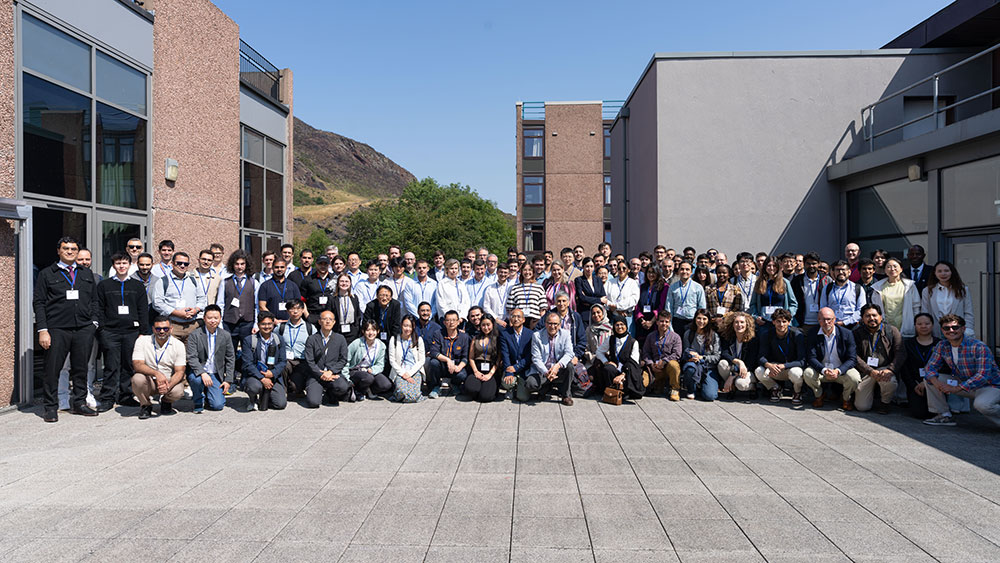
Team photo of the CSNDSP 2026 conference 15th-17th July 2026

From 15–17 July 2026, researchers from around the world gathered at the University of Edinburgh for the IEEE 15th International Symposium on Communication Systems, Networks and Digital Signal Processing (CSNDSP 2026). Since 1998, CSNDSP has become a leading forum for researchers and industry specialists to share ideas, present research and discuss future communications technologies.

The symposium comes at a time when communications technologies are evolving faster than ever. Exploring the future of global connectivity, this year’s agenda dived deep into innovations such as 6G networks, optical wireless and AI, cyber security and energy-efficient networking. Through keynote talks, technical sessions, specialist colloquiums and poster presentations, delegates had the opportunity to share new research, build international collaborations and discuss solutions to some of the sector’s most pressing technical challenges.

Representing HASC, Dr. Pranav Sharda presented his research on the topic “Indoor Visible Light Communications: Modelling and Channel Bandwidth Aspects of a Real Indoor Office Room”. Following the symposium, we caught up with him to discuss his research, the value of participating in international conferences such as CSNDSP, and the key insights he brought back from this year’s event.

Dr. Pranav Sharda PhD, Postdoctoral Research Fellow, University of Oxford, HASC

Why Did You Attend IEEE CSNDSP 2026?

There were three things pulling me towards CSNDSP this year, summarised below:

The first was simply to put my work in front of the research community. I presented my research on optical wireless communications and desired honest feedback from researchers working in the same space – not just recognition, but genuine critique. That kind of scrutiny provides feedback on whether a contribution truly holds and directs to where the work needs to go next, so it is crucial.

The second was the people. A conference like this is as much about the conversations in the corridor as the talks on stage, and this year delivered a couple of exchanges I’ll definitely be following up on. I had a great discussion with Prof. Rafael Perez Jimenez, a co-author on a poster covering ontology-driven social digital twins with optical camera communications localisation for real-time customer-service operations – in plain terms, using light-based optical cameras to track people and objects in real time and feed that into a live digital model of a space, for things like smarter customer service. It’s a genuinely different angle on optical wireless that I hadn’t considered applying in that context. I also spent time with Hichem Zimi from the University of Strathclyde, whose poster covered 1.5 Gbps optical wireless communications using far-UV-C micro-LEDs – essentially, very fast wireless data sent over a part of the light spectrum invisible to the human eye. It was a great knowledge exchange, and high-speed UV-C links are a direction I’ll be keeping an eye on.

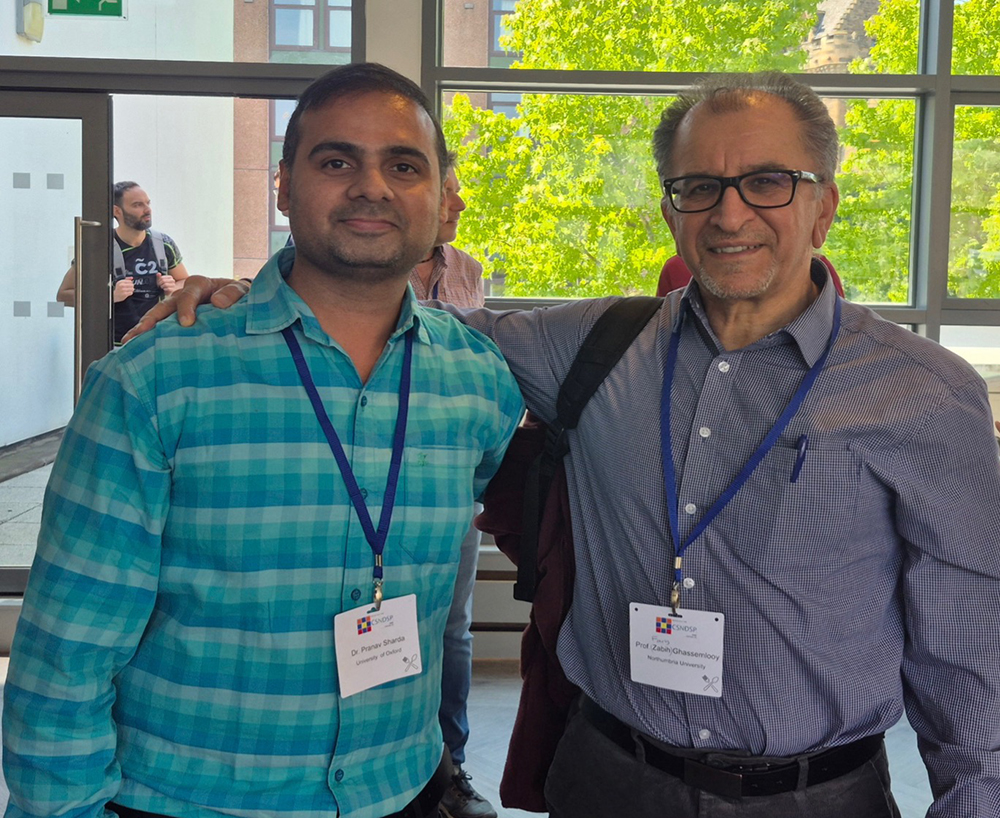
Left to right:  Dr. Pranav Sharda PhD, Postdoctoral Research Fellow, University of Oxford, with Professor Fary at CSNDSP26

Conversations like these are exactly why in-person events still matter: they open research directions you wouldn’t stumble across from a literature search alone, and they’re often where future research collaborations start.

The third reason was simply to see what else is happening in the field. Communication systems and wireless research move quickly, and CSNDSP is a good snapshot of where the community’s attention is heading next.

Tell Us About Your Research

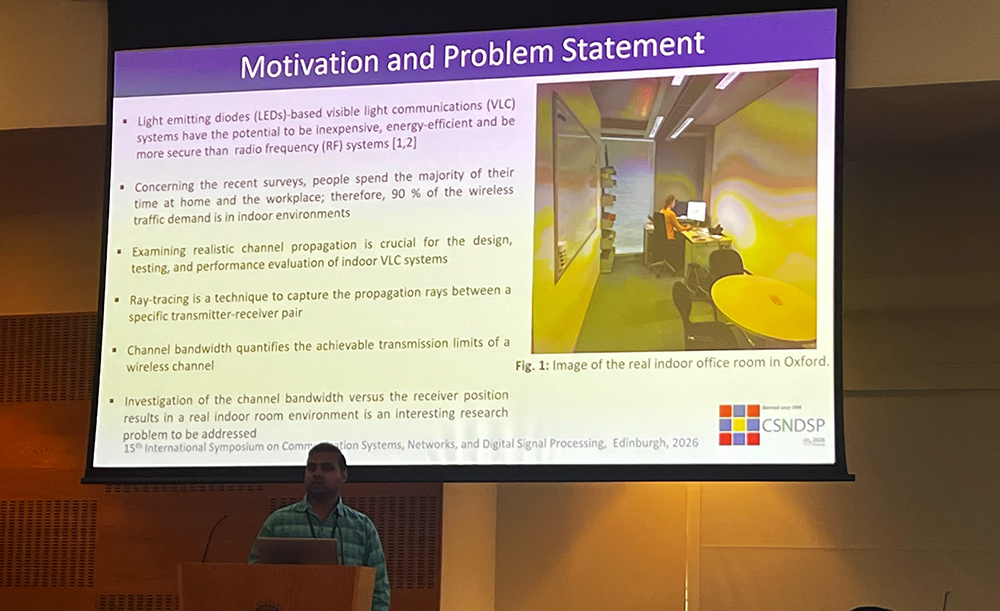
At CSNDSP 2026, I presented my research paper entitled “Indoor Visible Light Communications: Modelling and Channel Bandwidth Aspects of a Real Indoor Office Room”.

The research idea in brief: Indoor visible light communication (VLC) is emerging as a genuinely useful technique to deliver wireless connectivity inside buildings, using the same LEDs that light a room to also carry wireless data.

The research problem: Most VLC research relies on idealised, generic room models. That’s fine for early-stage theory, but it doesn’t tell you much about how the technology will actually perform once it meets a real space, including furniture, challenging layouts, reflective surfaces, etc. Therefore, I modelled a real indoor office room in Oxford to study how VLC-based optical wireless signals practically propagate through it.

Research finding: In plain terms, how fast and reliable your optical wireless connection is, depends strongly on exactly where you’re sitting in the office room. If we move our desk a metre, the usable data rate can shift noticeably. Technically, I measured this by tracking the 3 dB channel bandwidth.  The standard metric for how much data a VLC-based indoor optical wireless link can carry as a function of receiver position, employing commercial LEDs mounted along the ceiling’s central axis. That gives a realistic, end-to-end picture of optical wireless performance, rather than the idealised best-case numbers most VLC studies report.

Dr. Pranav Sharda presents his research paper entitled “Indoor Visible Light Communications: Modelling and Channel Bandwidth Aspects of a Real Indoor Office Room”, at CSNDSP26

The research solution: I built a real office room in Oxford as a full model in Zemax OpticStudio, a commercial optical design tool, creating a foundational indoor VLC model that other researchers can extend for future studies. It also gives engineers a way to test and verify a proposed VLC system before committing to real-world deployment. This matters immensely, because physical testing is expensive and time-consuming.

Why it matters beyond the lab: It has attracted great interest from industry. I’ve had encouraging conversations with both Ericsson and Nokia Bell Labs. Particularly, Sebastien Nigo from Nokia Bell Labs attended CSNDSP 2026. In April 2026, I presented these results directly to the Ericsson team, and they found the work genuinely interesting. The model, and the concrete propagation data it produces, is exactly the kind of input that design engineers need when planning real, commercial indoor VLC deployments.

What Are Your Key Takeaways from the Event?

  1. Spectrum frugality will define 6G- from Prof. Muhammad Imran (University of Glasgow)

Every generation of wireless connectivity, for instance, 2G through 5G, has solved wireless traffic demands by requiring more spectrum. Prof. Imran’s keynote made the case that this existing approach is running out of road. The next generation won’t be judged by how much new spectrum it can claim, but by how efficiently, or rather how ‘frugally’, it uses the already available spectrum. That’s a real shift in mindset for the field, and one with obvious relevance to optical wireless: VLC uses the unlicensed light spectrum, sidestepping the RF congestion problem entirely.

  1. Rethinking power, not just batteries – from Prof. Nuno Borges Carvalho (University of Aveiro)

As the number of connected electronic devices keeps climbing, so does our collective dependence on batteries. Prof. Carvalho’s talk on wireless energy transfer was a reminder that either reducing battery reliance or alternatively extending battery life needs to become a first-order design goal for wireless systems, not an afterthought.

  1. AI needs guardrails, even in technical research

The third theme running through the event was the responsible use of AI in research. It’s a timely message. As AI tools become embedded in how we design, simulate and analyse wireless systems, it’s easy to lose sight of research ethics and rigour along the way. If utilised carelessly, AI can quietly compromise the integrity of the work it’s meant to accelerate.

Conclusion

Dr. Sharda’s trip to CSNDSP 2026 is a good example of what conference attendance is actually for. It is not just the poster or the presentation slot, but the value of putting research in front of the people best positioned to challenge, extend, and use it. A model built with an aim to test an indoor office room in Oxford is now on Ericsson’s and Nokia Bell Labs’ radar. Further, a conversation over a poster session has opened the door to work on UV-C optical links and social digital twins that didn’t exist in the plans a month ago.

For HASC, it’s a useful snapshot of where the wider field is heading, i.e., toward spectrum efficiency, smarter power management, and more responsible use of AI in research itself. It is a reminder that our own work on optical wireless sits right at the centre of that conversation. We’ll be following where these new collaborations lead and looking forward to seeing what Dr. Sharda brings back from the next one.


If you would like to be the first to hear the news from across our consortium, including HASC’s work on optical wireless communications, you can sign up for updates here.

AI and LLMs in Research: What You Need to Know

If you’ve been wondering whether artificial intelligence is actually useful for research, or whether it’s just hype, the short answer is: it’s real, it’s here, and it’s moving fast.

We recently sat down with Alok Sahu, Senior Research Software Engineer at the AI Competency Centre, University of Oxford, to talk through what’s changed, what’s possible, and what researchers should be doing about it.

Why are LLMs Relevant to Research and Why Now?

Researchers have always worked with considerable volumes of text, reading papers, writing them, taking notes and reviewing others’ work. So, tools that handle text more efficiently have always had direct relevance. What’s shifted dramatically in the last couple of years isn’t the idea of using AI, it’s the quality of what these models can actually now do. Where they once struggled beyond a simple sentence completion, they can now summarise multiple long documents, draft and debug code, and carry out complex multi-step tasks with limited supervision.

The Leap to Agentic AI

One of the most significant recent developments is agentic AI – models that don’t just generate text but take actions. They can run literature searches, extract data from research papers, search the web, and return results, all in one workflow. For researchers, this opens up possibilities that simply weren’t practical before.

AI Is Not Just for One Field

The applications span multiple industries and sectors. In agriculture, Alok discussed with us, how AI is being used to predict crop yields and monitor fields. In construction, it’s flagging unsafe worksite behaviour and running design simulations. In healthcare, specialist models are emerging that can assist with drug discovery and genetic analysis. Whatever your research domain, there’s likely something relevant already developing.

New to LLM’s and AI? Where to Start

Alok’s advice is straightforward: dive in. Try the tools, experiment with your prompts, and see how the outputs change. Beyond the general platforms like ChatGPT, Claude, and Gemini, it’s worth exploring whether specialist models exist in your own field. The pace of development means domain-specific tools are emerging all the time.

The gap between those engaging with AI and those who aren’t is widening. The good news is it’s not too late to start and there’s no better time than now.

Watch the full conversation on our YouTube channel.

Connect with Alok:  https://www.linkedin.com/in/alokkrsahu/ 

Follow the AI Competency Center: https://www.linkedin.com/groups/15690177/ 

Why Mobile Networks Are Still Building Two of Everything, and the Sheffield Team Changing That

SMALLER, CHEAPER & GREENER MOBILE NETWORK HARDWARE

Mobile networks are quietly one of the most energy-intensive parts of our digital infrastructure. The towers, antennas, and radio units that keep us connected consume enormous amounts of power – and much of that consumption comes not from inefficiency in the obvious sense, but from a fundamental design problem that the industry has largely accepted as unavoidable. That is, until now.

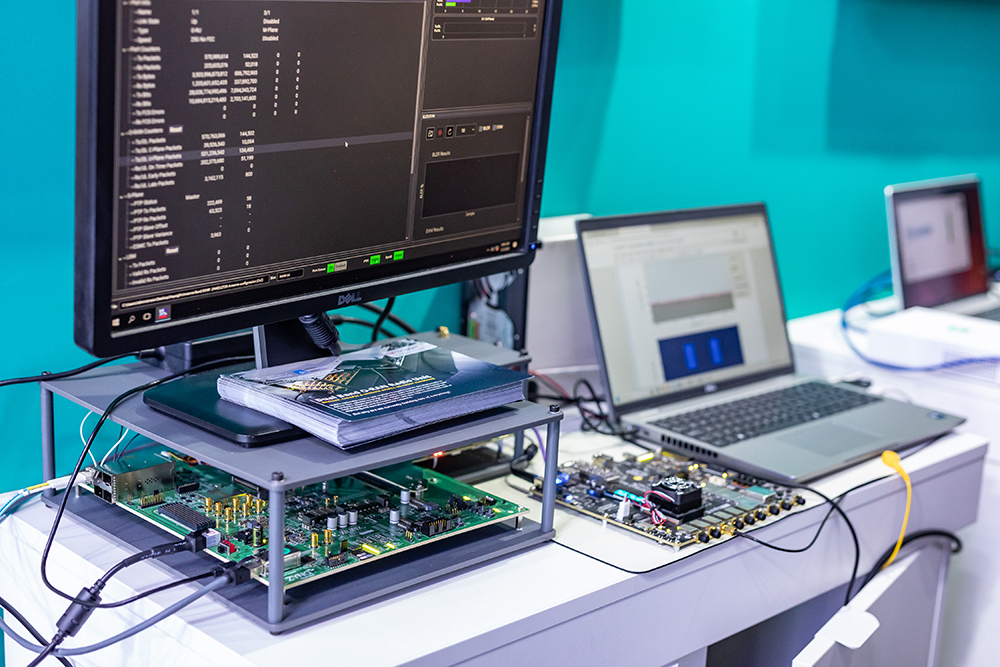
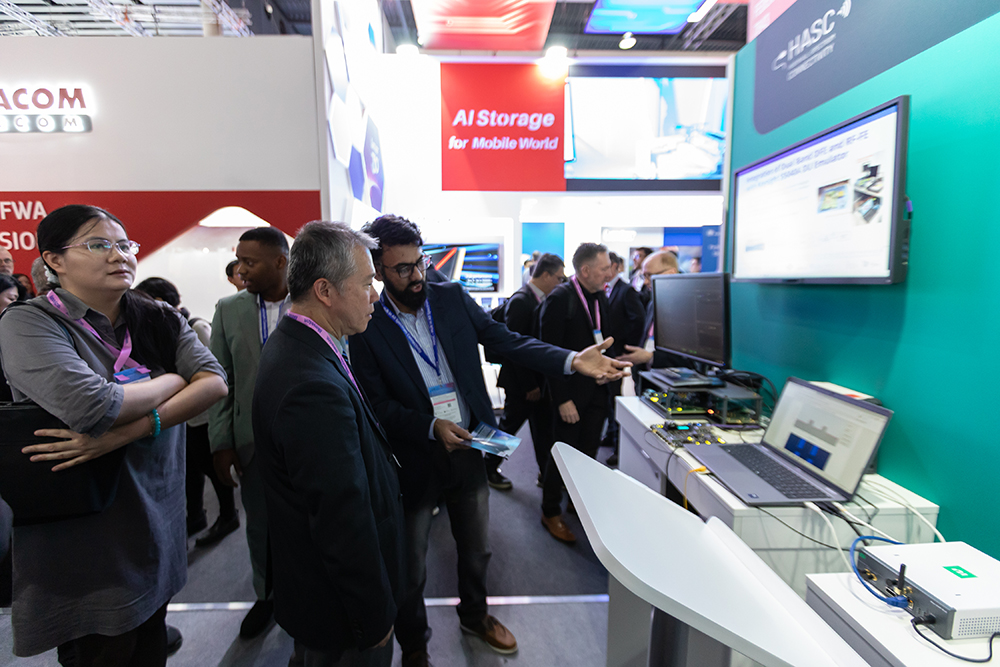
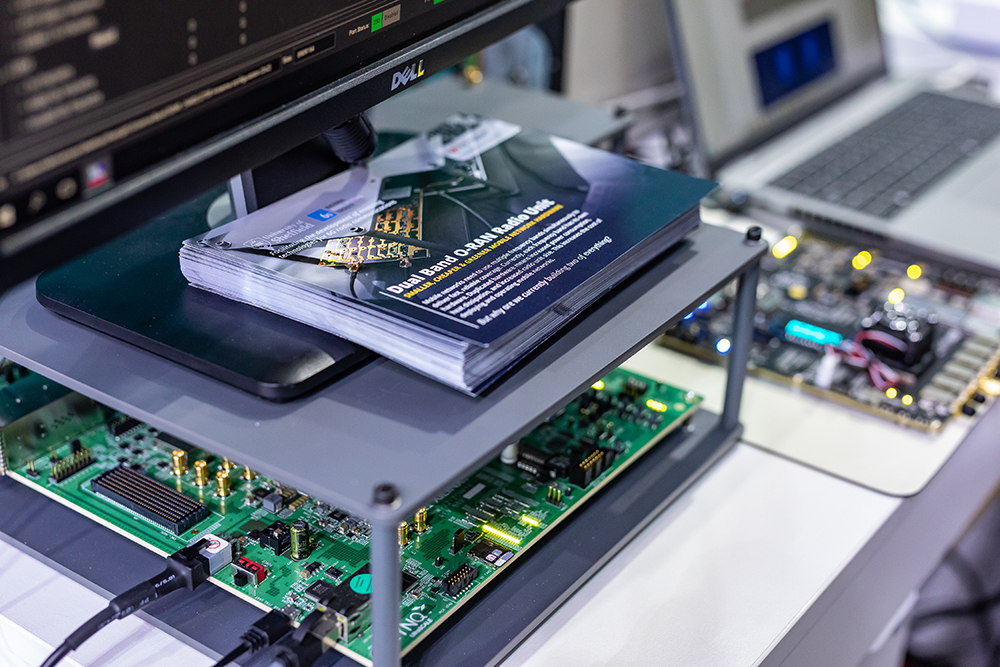
University of Sheffield demonstrates its Dual Band O-RAN Radio Unit at MWC2026

The Problem: Duplicated Hardware, Multiplied Costs

Modern mobile networks operate across multiple frequency bands simultaneously. A single base station might need to serve users on a mid-band 5G frequency while also handling a separate private network on a different band. The way this has traditionally been handled is straightforward, but wasteful: build a separate radio unit for each band.

Two bands. Two sets of hardware. Two sets of power draws. Two sets of components to manufacture, deploy, and maintain.

Multiply that across thousands of base stations and the cost and carbon implications become significant. It’s one of the reasons that energy expenditure is a major operational burden for mobile network operators – and a genuine obstacle to meeting net-zero targets.

The question the University of Sheffield’s Wireless Communication Systems team set out to answer through the YO-RAN project was simple: why are we building two of everything, and can we stop doing that?

From top to bottom:  Dr. Mubasher Ali discusses the Dual Band O-RAN Radio Unit innovation with the Industrial Technology Research Institute (ITRI) (業技術研究院, 工研院)
From top to bottom: Dr. Mubasher Ali discusses the Dual Band O-RAN Radio Unit innovation with the Industrial Technology Research Institute (ITRI) (業技術研究院, 工研院)

The Solution: One Radio Unit, Two Bands, a Single Shared Architecture

Demonstrated at Mobile World Congress 2026 in Barcelona, the Dual Band Open-RAN radio unit represents a significant step towards a leaner and more efficient model for mobile network hardware.

The core innovation is architectural. Rather than pairing two independent radio chains – each with its own digital-to-analogue converter (DAC), analogue-to-digital converter (ADC), and RF components – the Sheffield team has developed a radio unit in which two frequency bands share a single RF chain. Specifically, the prototype operates across the n78 (3.5 GHz) and n77-upper (4.005 GHz) frequency bands, which together cover both public 5G networks and private enterprise deployments.

The digital front-end (DFE) is built on the AMD/Xilinx ZCU670 RFSoC platform, a high-performance reconfigurable system-on-chip that handles two component carriers simultaneously. On the analogue side, a custom-designed RF front-end board manages both bands through shared circuitry – a single low-noise amplifier (LNA) for the receiver, and a shared transmit path enhanced with digital predistortion (DPD).

Dual Band O-RAN Radio Unit Demo

That last technique is worth pausing on. Power amplifiers are most efficient when operating close to their maximum output – but pushing them too hard distorts the signal. DPD corrects for that distortion digitally, allowing the amplifier to run at a more efficient operating point without sacrificing signal quality. It’s a meaningful contributor to reducing the overall power consumption of the unit. The result: fewer components, lower power draw, and a smaller physical footprint – without sacrificing performance.

Validated Against Industry Standards

Innovation in radio hardware only exists so far without interoperability. Open RAN – the disaggregated, vendor-neutral architecture that is reshaping how mobile networks are built – requires radio units to communicate with distributed units (DUs) from different suppliers using standardised interfaces.

The Sheffield prototype has been validated using the Keysight S5040A Distributed Unit Emulator, demonstrating compliance with the O-RAN 7.2x fronthaul interface specification. End-to-end testing confirmed that the dual band unit can exchange 5G NR signals cleanly across both frequency bands, with fronthaul synchronisation and RF chain performance verified across the full signal path.

Professor Timothy O'Farrell FREng, 6G National Radio Systems Facility, University of Sheffield
Professor Timothy O’Farrell FREng, 6G National Radio Systems Facility, University of Sheffield
Professor Timothy O’Farrell FREng, University of Sheffield

This matters for the commercialisation pathway. A radio unit that works in a lab is one thing; a radio unit that can plug into a real Open-RAN ecosystem and interoperate with third-party DUs is quite another.

“The opportunity to present our neutral host, dual band, O-RAN radio unit technology at MWC was immensely valuable. The realisation of two concurrent, independent frequency bands on a unique single RF architecture yields significant cost and energy consumption savings. MWC and the HASC Hub provided the ideal environment to showcase this advanced radio technology, supporting our pathway to commercialisation and exploitation.”

~ Professor Timothy O’Farrell FREng,

Why This Matters Beyond the Lab

The implications of this work extend well beyond hardware engineering.

For network operators, a single compact radio unit covering two bands means lower capital expenditure on hardware, reduced installation complexity, and lower energy bills over the lifetime of the deployment. For operators running neutral-host models – where a single piece of infrastructure serves multiple operators or use cases – the ability to allocate the two bands independently is particularly powerful.

For vendors and the Open-RAN supply chain, simplified radio designs with fewer duplicated components reduce manufacturing costs and open up opportunities to deliver more competitive, sustainable products into a market that is increasingly cost-sensitive.

For society and the environment, the arithmetic is straightforward: lower-power radio units, deployed at scale across national and international networks, contribute significantly to reducing the energy footprint of mobile connectivity. At a time when both governments and operators are under pressure to demonstrate credible progress toward net-zero, such hardware-level efficiency gains matter.

The YO-RAN project, funded by DSIT, is one of a portfolio of research programmes housed within Sheffield’s National 6G Radio Systems Facility, a £2.4m testbed that provides one of the UK’s most capable platforms for physical layer 6G research.

What Comes Next

The prototype demonstrated at MWC is an early-stage proof of concept designed to establish that the architecture works and to inform the next phase of design refinement. Characterisation results from the prototype are now being used to optimise the hardware toward higher-TRL versions with improved RF performance and tighter integration.

The team is actively seeking research collaborators and industry partners to help accelerate that journey from prototype to deployment. If you’re working in network infrastructure, Open-RAN, spectrum policy, or sustainable connectivity and want to explore what a partnership might look like, get in touch.

6gfacility@sheffield.ac.uk  

The YO-RAN project is funded by the Department for Science, Innovation and Technology (DSIT). The National 6G Radio Systems Facility is funded by EPSRC. The work was presented at Mobile World Congress 2026, Barcelona, with support from the Hub for Access to the Spectrum Community (HASC).


Standards-Agnostic AI: Teaching Networks to Learn to Communicate for Themselves

HASC Research Pillar: C2 Adaptivity | Imperial College London

What if a wireless network could learn to serve you better – without needing to ask where you are, what device you’re holding, or which way you’re facing? That’s exactly the question a team at Imperial College London set out to answer.

AI-Enabled CSI-Free Networks Advanced Mobile Connectivity

Led by Professor Kin Leung and Dr. Nancy Nayak, this research sits at the heart of HASC’s Adaptivity pillar – a challenge focused on building networks that can intelligently respond to changing conditions in real time. Their approach: replace the rigid, standards-dependent methods that underpin today’s mobile networks with something far more flexible. An AI that learns.

“We are not just jumping on to the band wagon of AI – we have developed AI-based wireless communication technologies which are fundamentally different from the conventional technologies used today.” ~ Professor Kin Leung, Imperial College London

“By designing wireless technologies with AI, we move beyond dependence on channel state information—unlocking faster development cycles and enabling networks to adapt to user needs and dynamic environments, unconstrained by standards.” ~ Dr. Nancy Nayak, Imperial College London

Why We’re Experimenting

The demand on wireless networks is accelerating. More users, more devices, more data – and the greater the expectation. People want and expect seamless connectivity everywhere, from city centres to crowded stadiums. Meeting those demands with today’s tools is increasingly difficult, and the gap between what users want and what networks can reliably deliver is widening.

The team at Imperial saw an opportunity to fundamentally rethink how networks allocate their resources. Rather than optimising within the constraints of existing standards, they asked: what if the AI could simply observe a network in action and learn the best way to manage it – without any of the traditional scaffolding?

The Industry Challenge

At the core of most modern wireless systems is something called Channel State Information, or CSI. This is data that describes the communication channel between a base station and a user’s device – think of it as the network’s way of understanding who’s where and how best to reach them.

The problem is that collecting and communicating CSI comes at a cost. For complex antenna systems (the kind increasingly used in 5G and future 6G networks) the overhead is significant. And because CSI exchange relies on standardised protocols, any improvement to the process must go through the slow, uncertain machinery of the international standards process, which can take years.

Base Station for Beam Forming - AI Enabled CSI-Free Networks

Add to this, the computational burden of recalculating antenna configurations as users move, and the challenge becomes clear: current approaches don’t scale well to the networks of tomorrow.

Our AI-Enabled Technology Innovation

The Imperial team has developed a Reinforcement Learning (RL) technique that sidesteps these constraints entirely. Their system allocates wireless resources (directing antenna beams and managing radio resources) without relying on CSI, user location data, or any information obtained through standardised protocols.

Instead, it learns. Using only the radio measurements already available within the network, the AI explores different resource-allocation strategies, receives feedback on what works, and progressively improves – just like a person learning a new skill through practice rather than instruction.

The results are striking. In testing, the approach achieves performance within 6% of the theoretical optimum for CSI-based methods – without any of the associated overhead. The system can also co-exist with conventional CSI-based approaches used by neighbouring base stations, making it compatible with real-world deployment scenarios.

Crucially, because the technology is standards-agnostic, operators don’t need to wait for industry alignment before deploying it. New antenna technologies and networking innovations can be adopted as soon as they’re ready.

The Impact of CSI-Free Networks 

The implications reach well beyond the lab. For network operators, this approach reduces complexity, lowers the cost of upgrades, and dramatically shortens the path from innovation to deployment. For users, it means more reliable connections in the places that matter most: busy transport hubs, large events, dense urban environments.

Dense Deployment - HASC Research Pillar- C2 Adaptivity | Imperial College London

Looking further ahead, the team is building a prototype for cellular network settings and exploring civilian and defence applications – with defence interest from Defence Science and Technology Laboratory (Dstl) and the Royal Air Force. The commercial opportunity is significant, with the short-term market for private 5G and enterprise networks estimated at $20–200 million, and long-term integration into baseband units pointing to a $0.5–1.5 billion opportunities. The global baseband unit market is ~$5–7B today and growing beyond $10B; as a core signal processing function (~5–20% share), resource allocations including beamforming underpin this serviceable segment  [1, 2, 3].

This is a project that doesn’t just improve a single component of how wireless networks function. It reframes how they can be built, deployed, and improved – putting adaptivity, rather than standardisation, at the centre.

Interested in this research or the path to commercialisation?  

We’re currently keeping our IP confidential while we finish our patent filings. At the same time, we’ve started building a live demo to show the tech in action. This demo is a key part of our spinout plan, as it will give investors a clear look at the value the new AI wireless technology brings to network users.

If you would like to get in touch with this project, please contact us here. 


When Networks Get Congested, People Lose More Than Just Signal

Meet ORLANDO – the AI-powered xApp making wireless networks smarter, safer, and more resilient

Picture a busy summer festival. Thousands of people are live-streaming, uploading, chatting and scrolling – and then an emergency happens. First responders try to make contact, but the network is overloaded. They can’t get through.

Network congestion isn’t just frustrating. In critical moments, it can be dangerous. This is exactly the problem that researchers at the University of York, in collaboration with Imperial College London, are working to solve – through a project called ORLANDO (O-RAN intelligent adaptive Load blaNcing and efficiency in highly Dense deplOyments).

Why We’re Experimenting

As we move towards 6G, networks must serve more devices, more applications, and more people – all at once, and in dense environments. The ability to balance traffic intelligently and adapt in real time, is no longer a nice-to-have. It’s essential.

ORLANDO sits within the HASC Core Challenge on Adaptivity: a research programme dedicated to building networks that can think, learn, and self-optimise. The project is investigating how AI and machine learning (ML) can be embedded directly into Open RAN (O-RAN) architecture to manage load balancing at scale.

The Industry Challenge

Dense O-RAN networks struggle to maintain performance under uneven traffic loads. When demand spikes (at a concert, a sports stadium, or a major public event for example) spectrum is wasted, latency climbs, and quality of service degrades. Traditional, rule-based systems simply can’t respond fast enough to keep up with the unpredictability of real-world demand.

Our Technology Innovation

ORLANDO is an AI-powered xApp – a software application that runs within the O-RAN Intelligent Controller (RIC) – designed to perform real-time network slicing and intelligent load balancing. Using a digital twin integrated with live network data and precise access point locations, the system simulates and optimises performance across different user load scenarios before applying changes to the live network.

The team is also training a traffic prediction ML model on real user movement and traffic data – and fine-tuning a generative AI to produce synthetic data for new or unforeseen environments. This makes ORLANDO not just reactive, but predictive.

The Impact of the ORLANDO Project

Already tested on the York O-RAN testbed – and due to be trialled in a real-world deployment in Blackpool – ORLANDO is designed to deliver tangible benefits: dynamic traffic prioritisation, optimised Quality of Service (QoS), and reliable connectivity for critical services, even at peak demand.

For citizens, this means fewer dropped calls, less buffering, and the confidence that emergency services will always be able to get through – even in a crowd. For industry, it signals a new era of intelligent, self-optimising networks – built not just for today’s demands, but for whatever comes next.

ORLANDO Team Showcase

The ORLANDO team, from left to right: Dr Yi Chu, Dr. Swarna Chetty, Dr. Mostafa Rahmani & project lead, Hamed Ahmadi, PhD, SM IEEE, FHEA

“In ORLANDO we move a step forward towards the AI-Native networks where we learn the user behaviour and train a scalable ML to predict network load and allocate network resources accordingly.” ~ Dr. Hamed Ahmadi, Reader in Digital Engineering

To connect directly with the ORLANDO researchers, register your here. 

See ORLANDO – The Intelligent Load Balancing xApp from University of York

Links, Papers & Further Resources    


Connect with Hamed Ahmadi

RF Physical Layer Security: Why It Matters

The security of communication networks is usually discussed in cryptographic terms, such as asymmetric cryptography and symmetric encryption. However, these cannot easily be applied to the billions of low-cost, limited-capability Internet of Things (IoT) devices coming online. This presents a major security risk, potentially giving malicious actors a back door into our private lives.

Yet every wireless connection – from a baby monitor to a satellite link – fundamentally depends on electromagnetic signals travelling through the physical environment. This ‘physical layer’ of radio frequency (RF) communication is becoming a promising new frontier for providing security across the wireless network.

What is RF physical layer security?

Physical layer security (PLS) describes security protocols applied to the very lowest layer of communications, and which exploit the inherent physical properties of channels. For RF PLS, this means harnessing characteristics such as noise, interference, and channel fading.

Unlike cryptography, which relies on the difficulty of solving a mathematical problem and hiding algorithms, PLS exploits physics – in particular the randomness of the wireless environment and the unique behaviour of real-world hardware.

Every wireless link has its own, location-dependent behaviour. Walls, furniture, other objects, and people moving around all cause signals to reflect, scatter and fade in ways that are unique to the positions of the transmitter and receiver.

Two legitimate devices in fixed positions ‘see’ the same rapidly changing channel between them and can treat it as a shared source of randomness for generating keys or authenticating each other. An eavesdropper in a different place, even a few wavelengths away (over 10 cm for Wi-Fi), experiences a different channel pattern, so cannot easily reproduce the same measurements or derive the same secret information. In this way, the physical environment itself becomes part of the security mechanism.

Why does physical layer security matter now?

Traditional cybersecurity tools have worked reasonably well for laptops, servers, and smartphones. These devices have powerful processors and large memories that can support heavyweight cryptographic algorithms.

The picture is different for the tens of billions of IoT devices now being deployed in homes, factories, cities, and elsewhere. Many of these sensors and embedded devices are:

  • extremely low cost,
  • battery-powered, with tight energy constraints,
  • designed for ‘install and forget’ deployments in unattended environments.

In these settings, strong cryptography can be difficult to deploy or maintain. PLS, on the other hand, can be implemented with lightweight signal processing, can operate continuously, and be applied to legacy devices. Ultimately, PLS is not a replacement for cryptography, but a way to raise the baseline for these vulnerable endpoints – the ‘Achilles heel’ of the network.

HASC leadership

Researchers within the Hub for All Spectrum Connectivity (HASC) are leading the charge in three PLS areas in particular:

  1. Physical-layer authentication

Physical-layer authentication uses channel measurements – for example, detailed channel state information – to create an ‘environmental fingerprint’ for a device. If a device suddenly appears with a channel profile that does not match its historical pattern, this could indicate spoofing or impersonation. HASC researchers have developed a practical deep learning-based physical-layer authentication scheme that can cope with mobile, time-varying wireless channels.

By training a neural network on a mix of synthetic and real Wi-Fi channel data, they reduced the amount of field measurements needed while still learning to distinguish between genuine devices and impostors. This shows that channel-based authentication can remain reliable even when users and devices are moving.

  1. Wireless key generation

In wireless key generation, two legitimate devices observe their shared channel and run signal-processing algorithms to extract a shared secret key from the common randomness in the channel. Because an eavesdropper does not see the same channel, they cannot easily derive the same key.

Much early work in this area has been based on a single link between a pair of users. However, in real IoT networks, a central node typically interacts with many devices. HASC researchers have addressed this challenge by designing an efficient multi-user key generation protocol based on Wi-Fi 6 orthogonal frequency-division multiple access (OFDMA), which allows a central node to split the spectrum into many subchannels and talk to multiple users at the same time. The protocol uses OFDMA capability so that the access point can probe and harvest randomness from several user channels in parallel.

HASC researchers have also conducted extensive experimental work on key generation for Wi-Fi and long-range IoT technologies, opening up additional security options for future multi-technology 6G systems.

  1. Radio frequency fingerprinting (RFF)

Every RF transmitter, even when manufactured to the same specifications, has subtle hardware imperfections in its amplifiers, oscillators, mixers, and other components. These imperfections imprint a unique, repeatable signature on the transmitted waveform.

Machine learning-based RF fingerprint identification (RFFI) can learn and recognise these signatures, enabling device-level authentication at the physical layer. Deep learning models, originally developed for image and speech recognition, are particularly well-suited to learning these patterns and classifying multiple signals.

HASC researchers have carried out comprehensive studies on exploring how RF fingerprinting could add an additional layer of security to networks the moment a device starts transmit information, without relying solely on user credentials. Their work ranges from LoRa, Wi-Fi, Bluetooth low energy to LTE.

HASC researchers at the University of Liverpool, Heriot-Watt University, and Queen’s University Belfast have demonstrated real-time RF fingerprinting using off-the-shelf Wi-Fi USB dongles, identifying which of multiple dongles sent a given packet based purely on their RF ‘fingerprints.’

Another HASC research focus is developing methods to ensure that RFF is applicable in the real world, and not just controlled, laboratory settings. For instance, a recent HASC study showed that advanced AI models, such as denoise diffusion models, can first suppress channel noise and effectively ‘amplify’ unique RF fingerprints, making them detectable and reliable even in noisy, real-world wireless environments.

Challenges and open questions

PLS could play a key role in supporting the UK Government’s Secure by Design agenda, and recently-introduced laws that require device manufacturers to implement minimum security standards.

But despite the rapid progress in PLS research, several challenges need to be addressed before this can become routine in commercial products:

  • Standardisation and integration: PLS techniques are not yet widely embedded in mainstream standards. Integrating them without disrupting existing communication systems is a major research and engineering challenge.
  • Scalability: Many experimental studies focus on tens of devices, but real deployments may involve thousands or millions of devices. Ensuring that key generation, authentication, and RF fingerprinting scale robustly remains an open question – one that requires more realistic testbeds and larger trials to answer.
  • Access to physical-layer data: Techniques like channel-based authentication often require detailed channel state information that is not typically exposed by commercial RF chipsets. Closer collaboration with chipset vendors and equipment manufacturers will be important to unlock these capabilities at scale.
  • All-spectrum connectivity: As we move towards a vision of multi-tech networks spanning RF, millimetre-wave, terahertz and optical links, this will create new opportunities to harness the diversity of channels for security – but also new opportunities for attack that need to be understood and managed.

PLS will never replace cryptography, but it offers a promising pathway to making wireless systems more resilient, adaptable, and trustworthy. By leveraging the underlying physics of the radio environment, HASC research is helping to make future networks inherently more secure from the moment a device connects.


With special thanks to Dr Junqing Zhang, University of Liverpool


The Role of the THz Spectrum in 6G and Beyond

The Role of THz and 6G

Even whilst 5G is still being rolled out worldwide, the groundwork for 6G is already being laid, with standards delivery expected around 2030. Data use worldwide is increasing exponentially (rising 15% in the UK between 2022 and 2023 alone), and this will only accelerate with the advent of emerging and future applications, such as autonomous vehicles, smart cities and immersive healthcare. This means that future telecommunications networks will need to deliver a step-change in capability, rather than incremental gains.

Introducing 6G is not only about faster downloads; the vision is for an extremely fast, ultra-reliable, low-latency, and intelligent communication fabric, achieving coverage everywhere and helping to close the digital divide. This network will also need the capacity to accommodate future 6G applications that demand extremely high data rates – and the terahertz (THz) spectrum is emerging as a promising candidate to extend standard technologies into new domains.

What is the THz Spectrum? 

The THz spectrum spans frequencies from around 0.1 THz (100 GHz) to 10 THz, with corresponding wavelengths from about 3 mm down to 0.03 mm – shorter than microwaves, longer than mid-IR/near-IR, and overlapping the far-infrared. What makes THz particularly appealing is the enormous amount of bandwidth available. This allows for ultra-high-speed connectivity, potentially supporting wireless data rates exceeding 100 Gbps – well beyond what is possible with 5G or even advanced mmWave.

Because of this, the THz band has become an active 6G research topic, with engineers and scientists worldwide exploring how it could reshape future mobile networks.

Why THz Spectrum for 6G? 

 The THz spectrum offers:

  • Massive bandwidth: Enabling peak throughputs of 100 Gbps and beyond.
  • Faster data transmission (lower latency): Because THz provides an exceptionally large bandwidth, each data symbol can be transmitted over a much shorter duration, reducing overall latency. In addition, the very high data rates available at THz frequencies make it possible to send information without compressing it first – avoiding the extra processing time needed for compression and decompression in lower-bandwidth systems.
  • Closer integration with optical fibre: THz signals can be generated directly from optical signals by photomixing (where THz radiation is generated by combining two different laser signals on a high-speed optical detector). This makes it possible to create seamless hybrid fibre-wireless networks, combining the reach of optical fibre with the flexibility of wireless.
  • Advanced sensing capabilities: Thanks to their very short wavelengths and unique interactions with different materials, THz signals can be used not just for data transfer but also for high-resolution imaging and sensing – enabling applications from gesture recognition to integrated communication-and-radar systems.

These qualities position THz as an enabler of the capabilities policymakers have identified for 6G: intelligence, sustainability, security and universal access.

Utilising the THz spectrum in 6G for Virtual Reality Applications

Utilising the THz spectrum in 6G could also unlock new innovations, including:

  • Immersive communication: Holographic conferencing, volumetric (3D) video and ultra-realistic augmented or virtual reality will demand ultra-high-speed connectivity with millisecond latency.
  • Data centre connectivity: Short-range high-speed comms using THz links could replace some fibre interconnects, reducing cabling complexity and cost.
  • Wireless backhaul: THz could provide fibre-like performance in places where laying fibre is impractical.
  • ‘Smart’ applications and automation: By enabling high-resolution sensing, THz could support applications that include ‘Internet of Things,’ ‘smart’ factories and cities, and autonomous driving – areas that require precise motion tracking and/or machine coordination.
  • Robotics: Highly-responsive connectivity and integrated sensing could enable advanced robotics, including for healthcare, surgery and industry.

Barriers and Challenges in THz

Despite its promise, THz communications face steep barriers:

  • Severe propagation loss: THz signals attenuate rapidly in free space and are highly vulnerable to obstacles and environmental conditions.
  • Short transmission ranges: Links are typically limited to tens of metres without special equipment.
  • Regulatory uncertainty: Unlike microwaves and mmWave, which already have clearly defined and regulated spectrum allocations, the THz band still lacks globally agreed allocations for communications.
  • Device engineering: Generating and detecting THz efficiently requires specialised photonic and electronic devices that are still under development.

Faster Data Lower Latency with THz 6g

HASC Research into THz 

To address these challenges, the Hub in All Spectrum Connectivity (HASC)’s THz research portfolio includes device development, optical-wireless integration and network modelling. Some highlights include:

  • THz–Optical Convergence: UCL researchers in HASC, in collaboration with the University of Duisburg-Essen and ACST GmbH, recently demonstrated the conversion of optical fibre signals into THz wireless links, achieving data rates up to 180 Gbps. This shows how existing fibre infrastructure could be seamlessly extended into the THz domain.
  • Dark fibre experiments: HASC is investigating the potential of the THz spectrum using the UK’s EPSRC-funded ‘dark fibre’ network. This gives researchers hundreds of kilometres of real-world fibre to test new ideas, such as carrying and regenerating THz signals over long distances to explore how to link high-speed fibre networks with future THz wireless systems.
  • Device innovation: A promising technology is the UTC-PD (Uni-Travelling Carrier Photodiode), which converts optical signals into electrical / THz signals. HASC researchers are developing new ways of housing and integrating ultra-fast UTC-PDs, so they deliver more power, handle higher speeds and work more reliably in THz transmitters and receivers.

HASC’s broader portfolio includes advances to provide the underlying capabilities needed to reliably generate, stabilise and harness THz signals within future 6G systems. These include developing methods to create ultra-high-frequency signals by combining laser sources, and designing advanced THz receivers that detect high-frequency signals efficiently and are compact enough for easy integration into real-world systems. Together, these efforts lay the groundwork for turning the promise of THz into practical, everyday 6G connectivity.

6G and Beyond

As the 2030 target for standardising 6G rapidly approaches, the next few years will see THz research move from controlled experiments to field-ready prototypes, allowing researchers to assess how THz can fit into the next-generation communications network. If the attractive qualities of THz are to support the vision for a robust, flexible future telecommunications network, it is vital that the challenges of THz propagation, regulation and device design are addressed.

Ultimately, no single technology will deliver 6G: instead, it is likely this will dynamically integrate THz, mmWave, microwave and legacy frequencies to balance coverage, mobility and capacity. For industry professionals and academics alike, the message is clear: keep watching the terahertz 6G research space. The next generation of wireless is being built now, and the exciting capabilities of THz are starting to take shape.


Want to stay involved? Keep an eye on our channels for updates, opportunities, and news from across the HASC community.

Sign up for our newsletter.

Follow us LinkedIn.

Find out how we work with industry.

The Latest Research on Next-Gen Connectivity

The vision for next-generation connectivity

Next-gen Connectivity Research is breaking down barriers between academia industry and policy

Each new mobile network generation has brought greater data capacity and faster downloads, and in this respect 6G will be no different. But the vision for future connectivity goes far beyond this. Instead of networks focused on transferring information from one point to another, the aim is for a system that embeds digital communications into the fabric of all areas of society – bringing unprecedented levels of connectivity, resilience and innovation.

Such a communications landscape would enable a far greater variety of nodes to come online, for instance autonomous vehicles and intelligent ‘Internet of Things’ devices. This will allow a wealth of new technologies to become mainstream, from smart cities and virtual healthcare, to immersive digital environments and even applications we can’t yet foresee.

HASC is a partner in the Federated Telecoms Hubs (FTH), working alongside hubs such as TITAN, CHEDDAR, and JOINER, to address this ‘grand challenge’ of connectivity. Our particular focus is on the underlying physical connections within this fabric.

The technology behind future connectivity

Achieving next-generation technology will require integrating both existing communications infrastructure and new domains into a single coherent architecture. This is expected to include:

  • New frequency bands, including millimetre-wave (mmWave) and terahertz (THz) frequencies, enabling ultra-fast, short-range data transfer in dense environments.
  • Advanced optical communications, using both fibre-optic cables and free-space laser links. These will provide an ultra-high-capacity backbone for data-intensive applications, such as data centres.
  • Radio systems, which will continue to provide reliable, wide-area coverage and mobility.
  • Artificial intelligence (AI) and machine learning to manage complexity and optimise performance dynamically.

Together, these elements form the foundation of HASC’s work on future connectivity: a spectrum-agnostic, adaptive network fabric that unifies the best of wired and wireless systems. Ultimately, this will ensure that the UK’s communications infrastructure of tomorrow is not only faster, but more intelligent, efficient, and secure.

How is HASC helping to bring next-gen connectivity forward?

Delivering next-generation connectivity is a multifaceted challenge, with hurdles to overcome across technology, regulatory and policy domains. To address these, HASC is leading a holistic research portfolio, spanning Modelling and Measurement, Connectivity, Adaptivity, and Security. In particular, the hub stands out for its work in both optical and radio frequency communications, with a goal of generating insight on how we can unite wired and wireless domains.

Three particularly promising new technologies that HASC are investigating are:

  • Hollow-core optical fibre (HCF)

This next-generation fibre technology guides light through air rather than solid glass, which has the potential to substantially reduce the signal delay and distortion that limit today’s conventional single-mode fibres. HASC is investigating how these fibres can enable ultra-low-latency, high-bandwidth communication while also supporting new capabilities. In recent work, HASC researchers demonstrated that hollow-core and multicore fibres can carry both optical power and communications simultaneously, with the potential to improve the resilience of networks by providing ‘back up’ power.

  • Integrating sensing and communications

One of the emerging frontiers in Future Connectivity is the fusion of sensing and communications into a unified system sharing spectrum, hardware and signals. HASC researchers are making the measurements that underpin some of this work.

  • Quantum key distribution (QKD)

QKD can be used to improve network security by applying quantum mechanics to create cryptographic keys that are theoretically immune to eavesdropping. HASC researchers are investigating how to integrate QKD into both wired and wireless systems, to enable tamper-proof communications. In a recent study, they demonstrated secure data transmission using quantum encryption at speeds of up to 5 Mb/s over 25 kilometres of fibre. The system used an innovative approach where each receiver generated its own local reference signal, rather than sending one through the fibre – a design that makes the link far more secure against interception or tampering.

Other areas that HASC researchers are exploring include hybrid fibre–wireless links that combine the capacity of optical fibre with the flexibility of mmWave wireless; intelligent surfaces to boost the propagation of weakly-penetrating signals; optical wireless integration for high-capacity data transfer over short distances; and how AI can be applied to improve spectrum utilisation and network performance.

Breaking down barriers between academia, industry, and policy

The road to 6G and next-generation connectivity can be accelerated through close alignment between industry, policy professionals and academic researchers. A strong example is HASC partner Imperial College London co-chairing the European Telecommunications Standards Institute (ETSI)’s Industry Specification Group, collaborating with a range of companies including BBC and Viavi. This pre-standardisation forum focuses on developing future multiple access techniques for 6G standardisation.

The Latest Research Next Generation Connectivity

Another case study is HASC’s collaboration with BT to develop Power-over-Fibre (PoF): a novel approach to delivering electrical power to communications equipment without relying on traditional copper cabling. As copper infrastructure is phased out in favour of all-fibre networks, the capability to support critical communications even during periods of local power outages is lost. PoF offers a promising alternative, enabling remote powering solutions in all-fibre communication systems. This work has already resulted in a series of demonstrations showing optical power delivery to remote equipment through the communication fibre, and several publications. The research is supported by BT, who developed the use cases motivating the investigation into PoF implementation solutions, sponsored a PhD studentship in this area, and loaned equipment for experimental network demonstrations.

Delivering the vision

Next-generation connectivity represents a paradigm shift in how we understand, design, and experience communication. Instead of treating modes as separate technologies, these will be united into a single, intelligent system.

 But there remain many unknowns. For instance, how can we diversify communications while reducing energy consumption and aligning with net zero targets? Can we leverage advances in quantum computing and integrate these into classical systems? How can we strengthen network security and resilience, for instance using new satellite capabilities?

These are difficult questions to address, and HASC is working together with our FTH partners to help answer them.


Want to stay involved? Keep an eye on our channels for updates, opportunities, and news from across the HASC community.

Sign up for our newsletter.

Follow us LinkedIn.

Find out how we work with industry.

mmWave and THz: Understanding the Differences

Young woman browses on her mobile device mmWave and THz Understanding the Differences

Demand for wireless connectivity is rising exponentially. As requirements for speed, capacity and reliability grow, engineers and researchers are pushing beyond today’s mobile technologies to explore new frontiers in the electromagnetic spectrum. Two promising candidates for future wireless technologies are millimetre wave (mmWave) and the terahertz spectrum (THz). Both sit in the high-frequency wireless end of the spectrum and promise extraordinary capabilities, but they also bring challenges. Understanding the differences, and how they might work together, is a task that the Hub in All Spectrum Connectivity (HASC) is fully embracing.

What are mmWave & THz?

The electromagnetic spectrum is divided into frequency bands. The higher the frequency, the shorter the wavelength and the more data that can be carried, though this often comes with greater transmission challenges.

  • mmWave typically refers to frequencies between around 24 and 300 GHz, with wavelengths measuring between 1 and 10 mm. mmWave is already being commercially deployed in US 5G networks (with the UK moving towards implementation) and is a core part of the discussion around 6G.
  • THz generally refers to frequencies from 100 GHz up to 10 THz (10,000 GHz), with wavelengths between 3 mm and 30 µm. This range offers a very large bandwidth and high-capacity transmission, making it a key candidate for meeting the data demands of future network applications.

Since the ranges of mmWave and THz overlap, the boundaries between these are not always rigid, and their characteristics can sometimes blur.

The Similarities and Differences of mmWave & THz

As mmWave and THz are both high-frequency bands, they share many fundamental traits. These include:

  • High transmission loss: signals weaken quickly as they travel, which limits range and requires more transmitters or repeaters.
  • Poor penetration: walls, furniture and even human bodies can block or absorb the signal, making indoor coverage difficult.
  • Line-of-sight requirement: reliable links often need a clear path between the transmitter and receiver, as signals do not bend easily around obstacles.
  • Environmental sensitivity: conditions such as rain, humidity or atmospheric absorption can further reduce performance.

However, mmWave and THz also have key differences:

  • Data rates: whilst mmWave could deliver high-speed connectivity to modern networks, the capabilities of THz far exceed this, with the potential for ultra-high data rates exceeding 100 Gbit/second.
  • Propagation and loss: THz frequencies experience even higher propagation loss than mmWave. This means that while they can transmit vast amounts of data, their range is more limited.
  • Penetration: both mmWave and THz have significantly lower penetration than radio frequencies. However, whilst mmWave can penetrate certain materials such as glass with manageable loss, THz waves penetrate much more weakly and are mostly restricted to direct, unobstructed paths.

In short: mmWave can travel further, while the THz spectrum can deliver more data over shorter distances.

Use Cases: Today and Tomorrow

mmWave today: mmWave is already finding its place in commercial systems. Telecoms are integrating mmWave into mobile networks to boost capacity and deliver faster wireless experiences. For users, this means higher speeds in dense urban centres, stadiums or transport hubs where data demand is extremely high.

Emerging THz applications: THz is currently much less commercially developed, but global interest and research is expanding rapidly. Potentially, THz in telecommunications could:

  • Replace short stretches of fibre optic cable, especially in areas where fibre installation is impractical or costly (for instance, across rivers or challenging terrain), or where fibre networks have been damaged during disasters such as earthquakes.
  • Enable short-range high-speed comms in data centres, where stable, ultra-fast links are essential.
  • Support advanced applications such as holographic conferencing or virtual reality/ augmented reality environments.

The exciting part is how the two might work together: mmWave providing robust, wide-area coverage, while THz delivers extreme data rates for high-capacity, short-range applications.

Challenges and Innovation

The main challenge for both mmWave and THz is overcoming the physical limitations of high-frequency signals, in particular, the fact they lose power quickly and don’t diffract around or penetrate obstacles well. Researchers are tackling these hurdles on multiple fronts:

  • Device engineering: building transmitters and receivers capable of generating and handling such high frequencies efficiently.
  • Hybrid integration: combining THz wireless with existing optical fibre infrastructure to extend range and resilience.
  • Algorithms and adaptation: designing systems that adapt dynamically to user movement and channel conditions, ensuring reliable connections even in difficult environments.

HASC Research Spotlight

At HASC, researchers are working to address key unknowns about the use of mmWave and THz in telecommunications. This has included measuring and modelling the performance of mmWave signals and their ability to deliver ultra-reliable WiFi in factory settings, and demonstrating the generation of precise THz signals by combining two different laser signals (known as photo-mixing) a technique which could reduce the implementation and operation cost of a THz communications system.

A strong focus is the integration of THz wireless with fibre networks to create seamless, end-to-end systems. For example, HASC researchers at UCL, in conjunction with German colleagues, have demonstrated a fully-optoelectronic 300 GHz wireless link, achieving up to 180 Gbps over 1.5 metres. This was done by mixing optical signals in order to generate and receive THz wireless signals. Such experiments show how fibre and THz wireless can be combined, paving the way for networks that are faster, more flexible and more efficient.

The Future: Complement, Not Compete

Looking ahead, it is unlikely that the future will be one of mmWave vs THz; instead of competing, these will complement one another:

  • THz will excel in scenarios demanding extreme data rates over short distances, such as data centres or specialised industrial environments.
  • mmWave will continue to support mobile users who need higher speeds than 4G/5G mid-bands can provide, while accommodating movement and broader coverage.

Together, mmWave and THz will form part of a flexible, multi-band ecosystem. This is central to HASC’s vision: an integrated network of wired and wireless systems, dynamically adapting to user needs. Through our research programmes and by brokering exchange between academia, industry and policy, HASC is working to accelerate the transition to a high-frequency wireless future.


Want to stay involved? Keep an eye on our channels for updates, opportunities, and news from across the HASC community.

Sign up for our newsletter.

Follow us LinkedIn.