

Researchers from the HASC-funded ORLANDO project have developed a new generative AI framework that could help overcome a longstanding challenge in wireless communications research: access to realistic, shareable network data.
Developing smarter, more efficient wireless networks depends on access to high-quality data. Yet, for researchers working in wireless communications and artificial intelligence (AI), obtaining the data they need has long been a significant challenge.
Real-world network data is often difficult to access because of privacy, security and commercial restrictions. Even when available, datasets may not capture unusual network conditions, such as sudden peaks in demand. These limitations make it difficult for researchers to test new technologies and compare results across different projects.
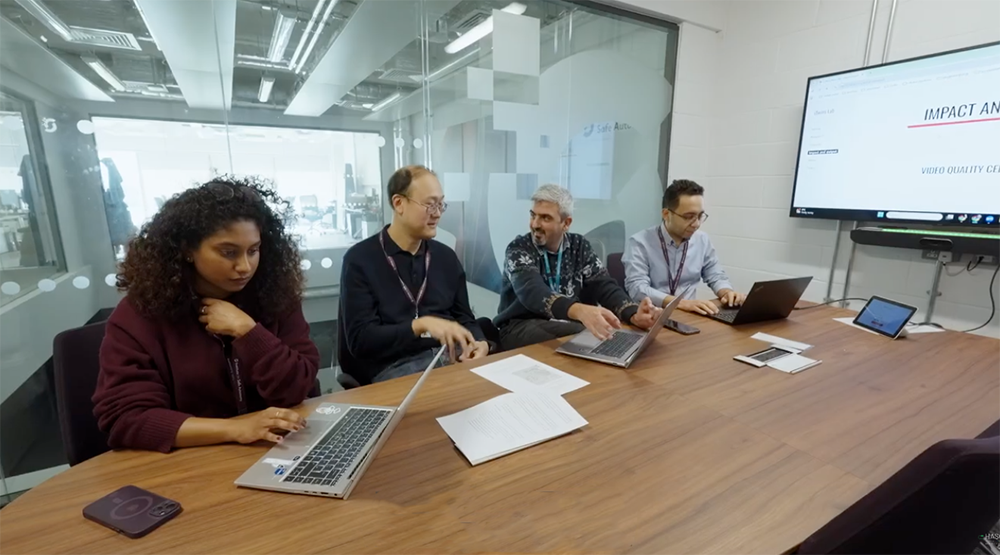
Now, researchers Mostafa Rahmani Ghourtani and Kavan Fatehi, working through the HASC-funded ORLANDO project at the University of York, have developed a new approach that could help address this challenge.
Their research, PhysDiff-Net: Physics-Guided Diffusion for Synthetic Wireless Traffic Generation, published in IEEE Transactions on Machine Learning in Communications and Networking, explores how generative AI can create realistic synthetic wireless network data that can be shared and reused by the research community.
Overcoming the data challenge
The lack of accessible, shareable network data has been a longstanding problem in wireless communications research, dating back to the early development of machine learning applications in networking.
Much of this data is owned by network operators and cannot be freely distributed. Even where researchers are granted access, non-disclosure agreements may prevent them from sharing it with other teams.
This creates a particular challenge for machine learning research. Without access to common datasets, researchers struggle to benchmark different approaches under comparable conditions or establish how well new technologies perform.
PhysDiff-Net offers a potential solution by generating synthetic data: artificially created information that reproduces important characteristics of real wireless network activity.
Unlike real-world datasets, appropriately generated synthetic data can be shared more widely, enabling researchers to test new approaches, compare results and build upon each other’s work.
For the research team, demonstrating this possibility represents an important achievement and a potential step towards overcoming a problem that has affected wireless networking research for decades.
Creating realistic data with physics-guided AI
What makes PhysDiff-Net particularly interesting is its combination of generative AI with an understanding of how wireless networks behave.
Rather than simply reproducing statistical patterns found in existing datasets, the framework incorporates knowledge of wireless network behaviour into the data-generation process. It also accounts for changes in network activity over time, helping the generated data reflect realistic operating conditions.
The model was trained using measurements collected over approximately five weeks from 11 access points in a municipal Wi-Fi network in Blackpool, UK.

Blackpool provided an interesting environment for the research, with network activity varying between busy weekends and event days alongside the quieter autumn and winter weekdays.
These variations helped provide the foundation for generating synthetic data that reflects changing patterns of network demand.
PhysDiff-Net also introduces techniques to preserve important statistical characteristics of the original measurements, helping researchers generate data that is both realistic and informed by the physical behaviour of wireless networks.
The result is a research framework that could help reduce reliance on repeated real-world data collection while providing a common foundation for testing and evaluating new wireless technologies.
What could this mean for future wireless networks?
Although PhysDiff-Net is currently a research framework, its potential applications extend beyond the generation of synthetic datasets.
One promising area is the development of network digital twins: virtual representations of real networks that allow researchers and engineers to explore how networks might behave under different conditions.
For example, researchers could use synthetic data to investigate how a wireless network might respond to a sudden increase in users during a major public event, without needing to recreate those conditions on a live network.
The framework could also support research into intelligent network management, including Open Radio Access Network (O-RAN) optimisation and load balancing, where network resources are distributed to manage demand more efficiently.
By generating realistic ‘what-if’ scenarios, researchers could test and benchmark algorithms designed to improve network performance and efficiency.
These applications remain areas for further research, but they demonstrate how realistic synthetic data could contribute to the development of more intelligent and adaptable wireless networks.
Collaboration, open research and what’s next
PhysDiff-Net was developed through collaboration between researchers with expertise in wireless communications, machine learning and network optimisation.
Mostafa Rahmani Ghourtani and Kavan Fatehi worked closely throughout the development of the framework, supported by contributions from Professor David Grace (University of York), Professor Mahnaz Arvaneh (University of Sheffield), Professor Kin K. Leung (Imperial College London) and Professor Hamed Ahmadi (University of York).
The team has also made its code and data available through GitHub, reflecting a commitment to open and reproducible research.
By providing resources that other researchers can use, compare against and develop further, the team hopes PhysDiff-Net will contribute to wider progress in wireless communications and machine learning.
The researchers are particularly interested in exploring further collaborations with universities, network operators and industry teams working in AI, wireless networking and digital twins.
For Mostafa, the publication also marks a personal milestone, as one of his final research projects at the University of York.
“We explored many different ideas before reaching the final framework, so seeing the work published is a very satisfying way to close that chapter, and I am very happy that we did it as a team.” – Mostafa Rahmani Ghourtani, Research Associate
With the framework now published and its resources made available to the wider research community, PhysDiff-Net provides a foundation for further investigation into how generative AI could help researchers develop and evaluate the wireless networks of the future.
Find out more
- Read the research paper: PhysDiff-Net: Physics-Guided Diffusion for Synthetic Wireless Traffic Generation
- Explore the PhysDiff-Net code and data on GitHub
- Read more about ORLANDO: https://allspectrumhub.org/2026/04/02/when-networks-get-congested-people-lose-more-than-just-signal/
- Lean more about the wider projects from iTwins-Labs: https://www.itwins-lab.com/
Sign up for the HASC newsletter to stay up to date.